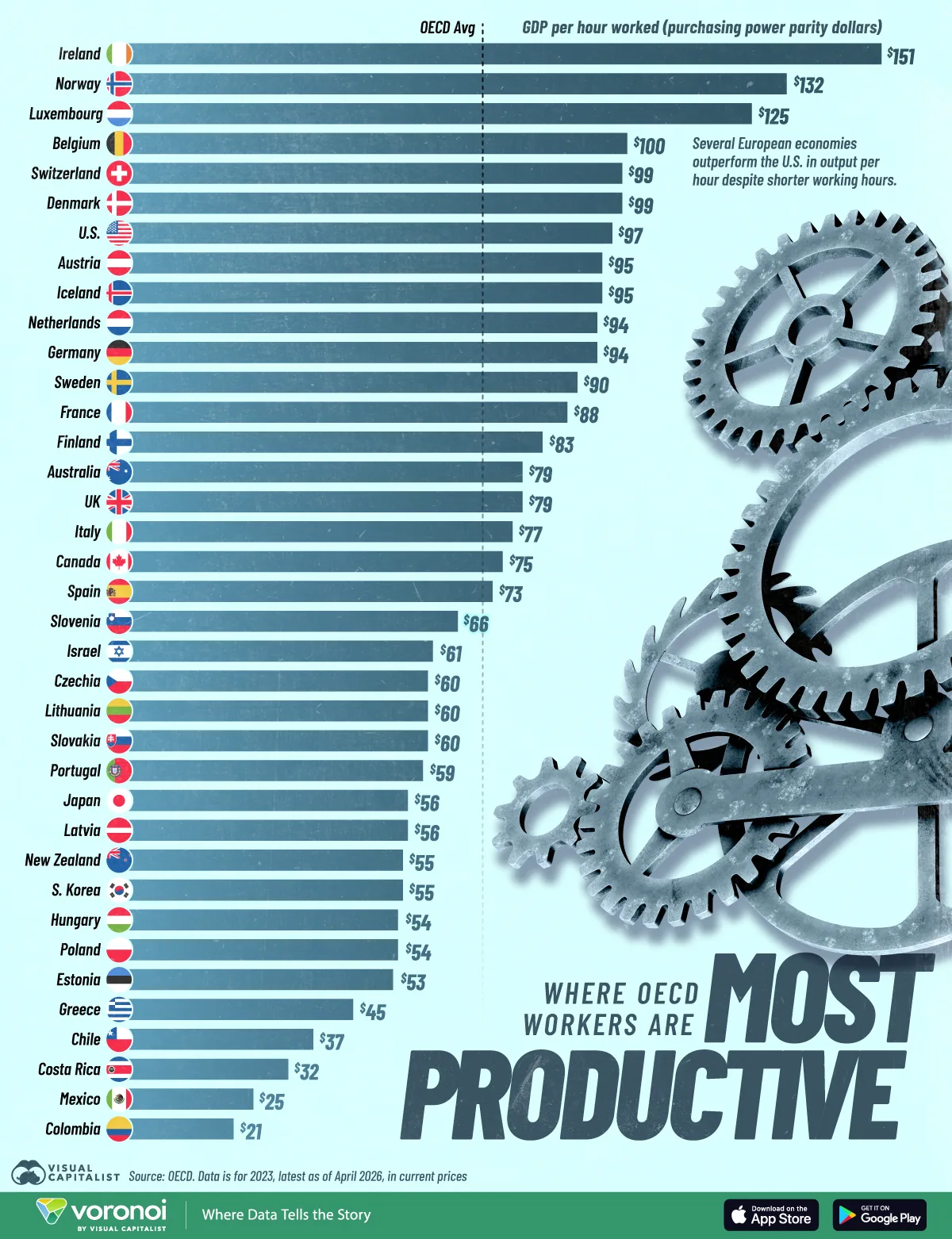
A new global ranking has placed Ireland at the top of the world’s most productive countries, with output per worker far exceeding that of other advanced economies.
The report, published by Visual Capitalist and based on data from the Organisation for Economic Co-operation and Development (OECD), compares countries using gross domestic product (GDP) per hour worked. This measure is widely used to assess how efficiently labour contributes to economic output.
According to the findings, Ireland leads the list with $151 in GDP per hour worked, well ahead of its closest competitors. Norway follows with $132, while Luxembourg ranks third at $125. Other European countries, including Belgium, Switzerland, and Denmark, also feature prominently among the top performers.
The United States records $97 per hour, placing it above the OECD average of $71 but still behind several smaller, high-income economies. Germany, the Netherlands, and Sweden are also ranked above average, reflecting strong industrial and innovation-driven sectors.
The report highlights that not all working hours generate equal economic value. It notes that countries with strong presence in technology, finance, and pharmaceutical industries tend to record higher productivity levels due to the capital-intensive nature of these sectors.
However, the data comes with important qualifications. In countries such as Ireland and Luxembourg, productivity figures are significantly influenced by multinational corporations. These firms often shift profits across borders, which can inflate GDP figures relative to actual domestic economic activity.
For instance, Ireland’s productivity drops by about 31 per cent when measured using gross national income (GNI), an alternative metric that excludes some of these external corporate effects. Luxembourg experiences an even sharper decline of 54 per cent under the same measure.
Norway’s high ranking is largely supported by its energy sector, while Luxembourg benefits from a strong financial industry. These structural advantages contribute to higher output per hour compared to economies that rely more on agriculture, tourism, or lower-value services.
The analysis concludes that differences in industrial structure play a major role in shaping productivity levels across countries, with knowledge-based and capital-intensive sectors driving higher efficiency.