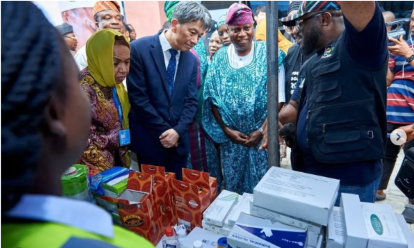
The Federal Government, in partnership with the Lagos State Government and UNICEF, has launched a renewed routine immunisation programme to close vaccine gaps and reach underserved communities across the state.
According to a statement by the Lagos State government, the initiative was officially launched on April 15, 2026, at the Badagry City Hall in Badagry.
The event brought together government officials, development partners, traditional rulers, health workers and residents.
The programme aims to build on the progress made during the Measles-Rubella campaign and expand access to life-saving vaccines, especially for children in remote and riverine communities.
Speaking at the event on behalf of the Lagos State Commissioner for Health, Prof. Akin Abayomi, the Director of Health Planning, Research and Statistics at the Lagos State Primary Health Care Board, Temitope Balogun, described the initiative as a major step in protecting children’s health.
She noted that Lagos, as Nigeria’s economic hub, faces rapid population growth, which creates both opportunities and challenges in delivering healthcare services.
Balogun highlighted that zero-dose and under-immunised children, especially in hard-to-reach areas, remain a serious concern that requires consistent efforts.
She explained that the partnership with the Republic of Korea and UNICEF will help identify children who missed vaccines, improve access, strengthen immunisation systems, and build the capacity of healthcare workers.
“The partnership with UNICEF and the Republic of Korea represents a strategic step toward closing immunisation gaps, improving equity in healthcare access, and ensuring that no child is left behind,” she said.
Also speaking, the Chairman of Badagry Local Government, Babatunde Hunpe, described immunisation as one of the most effective and affordable public health measures.
He said vaccination not only protects children but also strengthens herd immunity and prevents diseases such as measles, polio, diphtheria and meningitis.
“Diseases such as measles, polio, diphtheria, and meningitis remain preventable through timely vaccination, underscoring the need for sustained community participation,” Hunpe said.
He added that Badagry faces challenges due to its riverine and border communities, which often have limited access to healthcare, and said the programme will help bridge those gaps.
Hunpe urged parents, caregivers and community leaders to support the initiative by ensuring children receive their vaccines.
In his remarks, the Permanent Secretary of Lagos State Health District V, Oladapo Asiyanbi, said the district performed strongly during the Measles-Rubella campaign due to effective planning and community involvement.
He explained that the campaign targeted children aged nine months to 14 years and was carried out in markets, schools, religious centres and health facilities, where vaccines were provided free.
“The campaign, which targeted children aged nine months to 14 years, was successfully implemented through intensified community mobilisation, strategic outreach, and the dedication of healthcare workers who ensured vaccines were administered free of charge across markets, schools, religious centres, and health facilities,” Asiyanbi said.
He revealed that the district recorded the highest vaccination coverage in the state, contributing to an overall 95 percent coverage rate.
Asiyanbi also appreciated support from partners including UNICEF, the Republic of Korea and the World Health Organisation.
He further acknowledged contributions from stakeholders such as Rauf Ibrahim Yemarin, Samson Folorunso, traditional rulers, community groups and healthcare workers for the success of the programme.