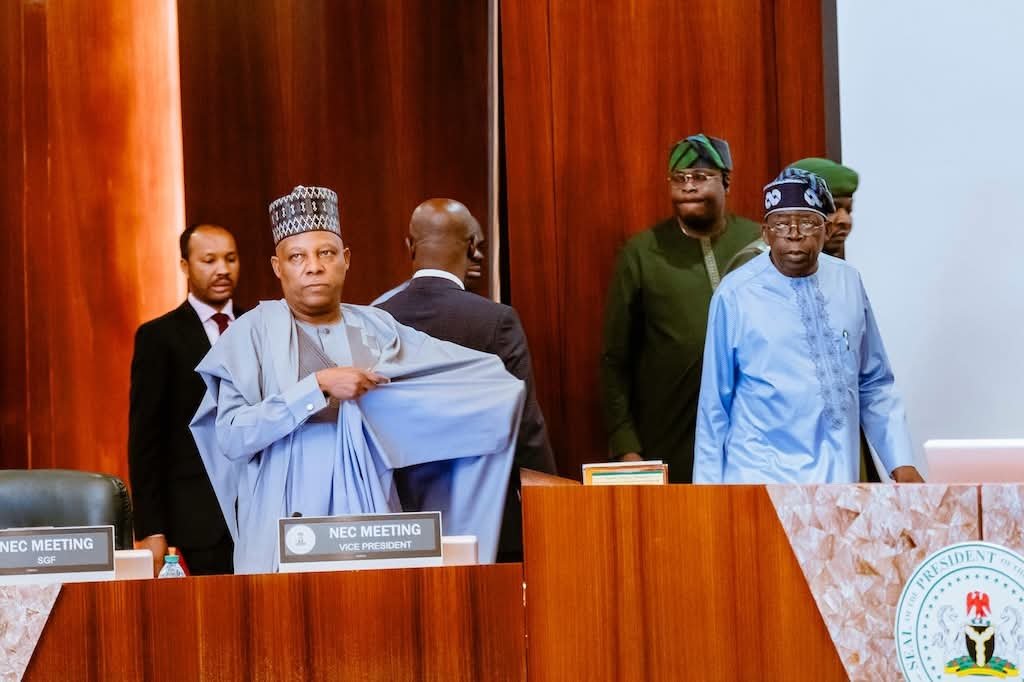
President Bola Ahmed Tinubu has urged Nigerian governors to invest more in grassroots development by focusing on poverty eradication, agricultural mechanisation, rural electrification, and infrastructure that will directly benefit ordinary citizens.
Speaking at the 150th meeting of the National Economic Council (NEC) held at the State House in Abuja on Thursday, the President charged state leaders to “change the story” of rural communities across the country and accelerate social protection initiatives.
“I want to appeal to you; let us change the story of our people in the rural areas,” President Tinubu said. “The economy is working. We are on the path of recovery, but we need to stimulate growth in the rural areas. Let us collaborate and do what will benefit the people.”
Tinubu emphasised the importance of collaboration between federal and state governments to stimulate economic development and improve living standards. He specifically called for the adoption of modern agricultural practices, increased rural electrification, improved school enrolment through school feeding programmes, and targeted poverty alleviation.
The President’s address followed a presentation by the Minister of Budget and Economic Planning, Senator Abubakar Atiku Bagudu, on the **Renewed Hope Ward Development Programme (RHWDP)** — a new strategy to fast-track grassroots development through direct interventions in Nigeria’s 8,809 administrative wards.
The NEC, chaired by Vice President Kashim Shettima, unanimously endorsed the RHWDP as a collaborative initiative between the federal, state, and local governments. The programme is anchored on President Tinubu’s *Renewed Hope Agenda*, which targets a \$1 trillion economy by 2030 through a 15% growth trajectory, far above the current sub-4% rate.
According to Senator Bagudu, RHWDP draws its legal strength from the 1999 Constitution and the Fifth Alteration Act, mandating state policies toward food security and improved agricultural methods. Each ward is expected to mobilise a minimum of 1,000 to 2,000 economically active individuals to sustain localized economic activity.
A National Steering Committee, representing all six geopolitical zones, will oversee the implementation of the programme, while the Ministry of Budget and Economic Planning will serve as the coordinating secretariat.
In another strategic move, President Tinubu directed the transfer of the Office of the Surveyor-General of the Federation to the Presidency This, he said, will ensure seamless coordination and execution of key national infrastructure projects, including the ambitious Lagos-Calabar and Sokoto-Badagry Superhighways.
The Council also addressed looming environmental risks, resolving to strengthen State Emergency Management Agencies (SEMAs) in all 36 states. The Federal Ministry of Finance was directed to release emergency intervention funds to mitigate the anticipated impact of flooding during the rainy season, following a presentation by the Director-General of the National Emergency Management Agency (NEMA), Mrs. Zubaida Umar.
The NEC meeting reaffirmed President Tinubu’s commitment to grassroots development as a foundation for Nigeria’s broader economic revival.