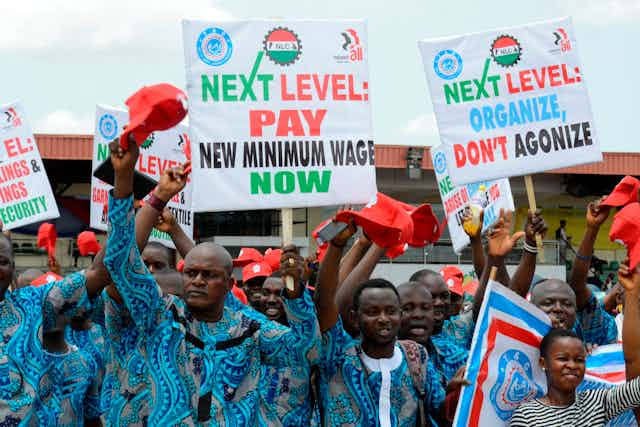
The United States government has expressed concern over the sustainability of Nigeria’s recently approved national minimum wage of ₦70,000, warning that it is inadequate to lift citizens out of poverty in the face of worsening economic realities.
In its 2024 Country Reports on Human Rights Practices, released on Tuesday, August 12, 2025, by the US Department of State’s Bureau of Democracy, Human Rights, and Labour, Washington noted that the new wage benchmark, valued at about \$47.90 per month at the prevailing exchange rate of over ₦1,500 to the dollar, has already been eroded by the continued depreciation of the naira.
According to the report, the gap between workers’ earnings and the rising cost of living is widening, leaving millions of Nigerians unable to meet their basic needs despite the wage increase. The US government also highlighted concerns over inflationary pressures, food insecurity, and the lack of social safety nets, which it said continue to undermine the welfare of low-income earners.
The Nigerian government, however, maintains that the ₦70,000 minimum wage was negotiated in good faith with organised labour and represents a significant improvement from the previous ₦30,000 wage structure. Officials have also pledged that measures are being put in place to stabilise the naira and cushion the effects of inflation.
Labour unions have yet to issue a formal response to the US report, though some leaders have previously warned that the new wage may quickly lose value without parallel efforts to tackle inflation, stabilise the exchange rate, and provide subsidies for essential services.