By Sabiu Abdullahi
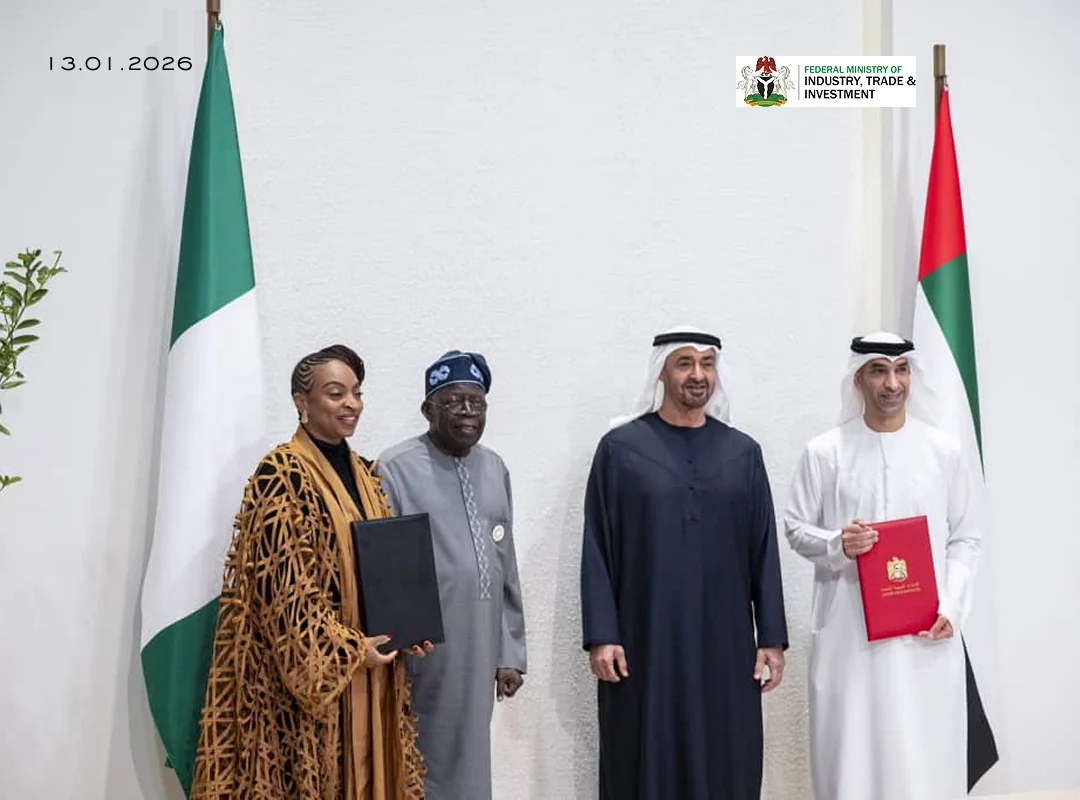
The Federal Government has signed a Comprehensive Economic Partnership Agreement with the United Arab Emirates to eliminate tariffs on a wide range of products traded between both countries.
A member of the Governing Board of the North East Development Commission, Rep. Sam Onuigbo, disclosed this on Tuesday during an interview with the News Agency of Nigeria in Abuja. He described the agreement signed in Abu Dhabi as a major breakthrough for Nigeria’s economy.
Onuigbo said the agreement, known as CEPA, was concluded during the Abu Dhabi Sustainability Week, which held from January 11 to January 15. He explained that the deal would significantly ease trade relations between Nigeria and the UAE.
According to him, “The CEPA was signed in January 2026, and the UAE will eliminate tariffs on 7,315 Nigerian products. This includes immediate duty-free access for 2,805 products (38.3 per cent), with the remainder phased out over three to five years, covering agricultural and industrial goods.”
He added that Nigeria also made tariff concessions under the same agreement. “Similarly, under the Nigeria/UAE CEPA, also signed in January 2026, Nigeria has eliminated tariffs on 6,243 products imported from UAE. That agreement creates these wonderful opportunities between Nigerians and the Emirates,” he said.
Onuigbo noted that the agreement would create opportunities for Nigerian business owners with verifiable enterprises to operate in the UAE. He said such business persons would be able to establish offices, work there for up to three months, and return to Nigeria.
He praised President Bola Tinubu for facilitating the agreement, stating that it was designed to reposition Nigeria’s economy, create employment opportunities, and improve overall national prosperity.
Onuigbo also highlighted Nigeria’s readiness for international business engagement. He said, “Nigeria is ready for business. Nigeria’s carbon market framework policy was unveiled again in Abu Dhabi.”
He further explained that Nigeria’s population size and long-standing energy challenges had limited its industrial growth. According to him, recent government actions showed a commitment to closing the energy gap.
He said, “Nigeria is a nation of nearly 250 million people and has had, over the years, the challenge of not having enough energy or power to be able to attain its economic and industrialisation targets.”
Onuigbo pointed to key initiatives such as the Energy Transition Plan, the Climate Change Act, and the Electricity Act, which President Tinubu signed shortly after assuming office in 2023. He said these measures underscored the importance of energy and electricity in driving industrial development.
He also commended Nigeria’s participation at the Abu Dhabi summit, noting that it would strengthen economic cooperation between Nigeria and the UAE. He added that the partnership would help address climate change challenges while supporting Nigeria’s economic growth in 2026.