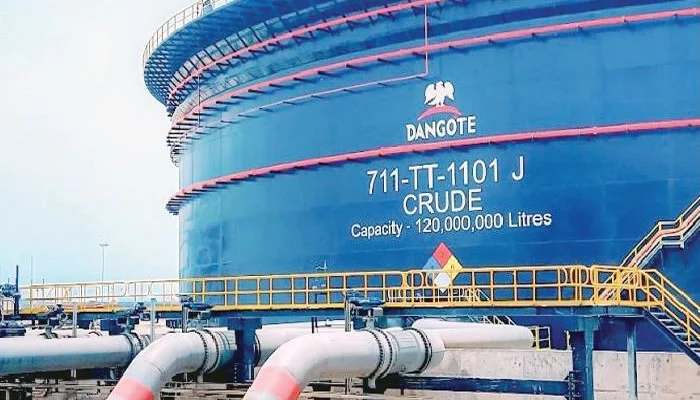
Dangote Petroleum Refinery has announced a reduction in the gantry price of Premium Motor Spirit, lowering the ex-depot rate by N25 per litre.
The new price dropped from N799 to N774 per litre. The adjustment was communicated to fuel marketers on Tuesday. The refinery also disclosed plans to expand its investment footprint to Burundi as part of its continental growth drive.
In a notice issued by its Group Commercial Operations Department, Dangote Petroleum Refinery and Petrochemicals FZE stated, “This is to notify you of a change in our PMS gantry price from N799 per litre to N774 per litre.”
The revised pricing took immediate effect. Industry pricing platform petroleumprice.ng also reflected the new rate after the announcement.
The refinery further informed marketers that its petrol lifting incentive programme had ended.
“Additionally, please note that the PMS lifting bonus ended at 12:00 a.m. on 10th February 2026. The corresponding credit for volumes loaded from 2nd to 10th February 2026, within the stipulated volume thresholds earlier communicated, will be posted to your account statement. Thank you for your continued partnership,” the notice read.
Market observers linked the end of the incentive window and the price adjustment to a broader shift in pricing strategy. They believe the refinery is moving away from volume-based incentives toward a more stable market structure as it strengthens domestic supply.
The development follows months of price volatility in 2025 after the deregulation of the downstream oil sector and the removal of fuel subsidies.
During that period, ex-depot prices fluctuated between N700 and above N800 per litre. Exchange rate instability, global crude oil prices, and reliance on imports contributed to the swings. However, local supply from the Dangote refinery later helped moderate prices, especially across southern distribution routes.
Earlier in 2026, the refinery had raised its gantry price to N799 per litre after selling at N699 during the festive season. The latest reduction to N774 per litre indicates easing cost pressures, improved operations, and competition from imported products and modular refineries expected to boost output.
Dangote Petroleum Refinery has a processing capacity of 650,000 barrels per day. It remains the largest single-train refinery in Africa. The facility plays a central role in Nigeria’s efforts to reduce dependence on imported petroleum products and conserve foreign exchange. Since entering the domestic PMS market, its pricing has influenced ex-depot benchmarks nationwide.
Meanwhile, the President of the Dangote Group, Aliko Dangote, is exploring fresh investment prospects in Burundi.
He visited the East African nation alongside former President Olusegun Obasanjo. The trip focused on assessing business opportunities and expanding the group’s African operations.
A statement from the conglomerate said the visit featured high-level discussions with Burundi’s President, Evariste Ndayishimiye, at the presidential palace. Dangote described the engagement as both diplomatic and commercial. He revealed that joint technical teams from Burundi and the Dangote Group had been set up to identify viable sectors for investment.
“Our focus really is investing heavily in the African continent, not anywhere else, and so Burundi is part and parcel of that African region,” Dangote reportedly said.
He pointed to opportunities in solid minerals, power generation, agriculture, cement manufacturing, and infrastructure. He stressed the intention to build partnerships that would promote mutual economic benefits.
According to the statement, talks also covered cooperation in logistics, industrialisation, energy and infrastructure. These sectors are considered critical to Burundi’s long-term economic ambitions and its plan to attract major private investors.
Analysts view the engagement as significant for Burundi’s investment outlook. They believe it strengthens the country’s position as a destination for large-scale African industrial investment while advancing Dangote Group’s continental expansion agenda.
The refinery’s petrol price reduction and the Burundi investment initiative reflect a dual strategy. The company aims to consolidate its influence in Nigeria’s fuel market while pursuing long-term growth across Africa.