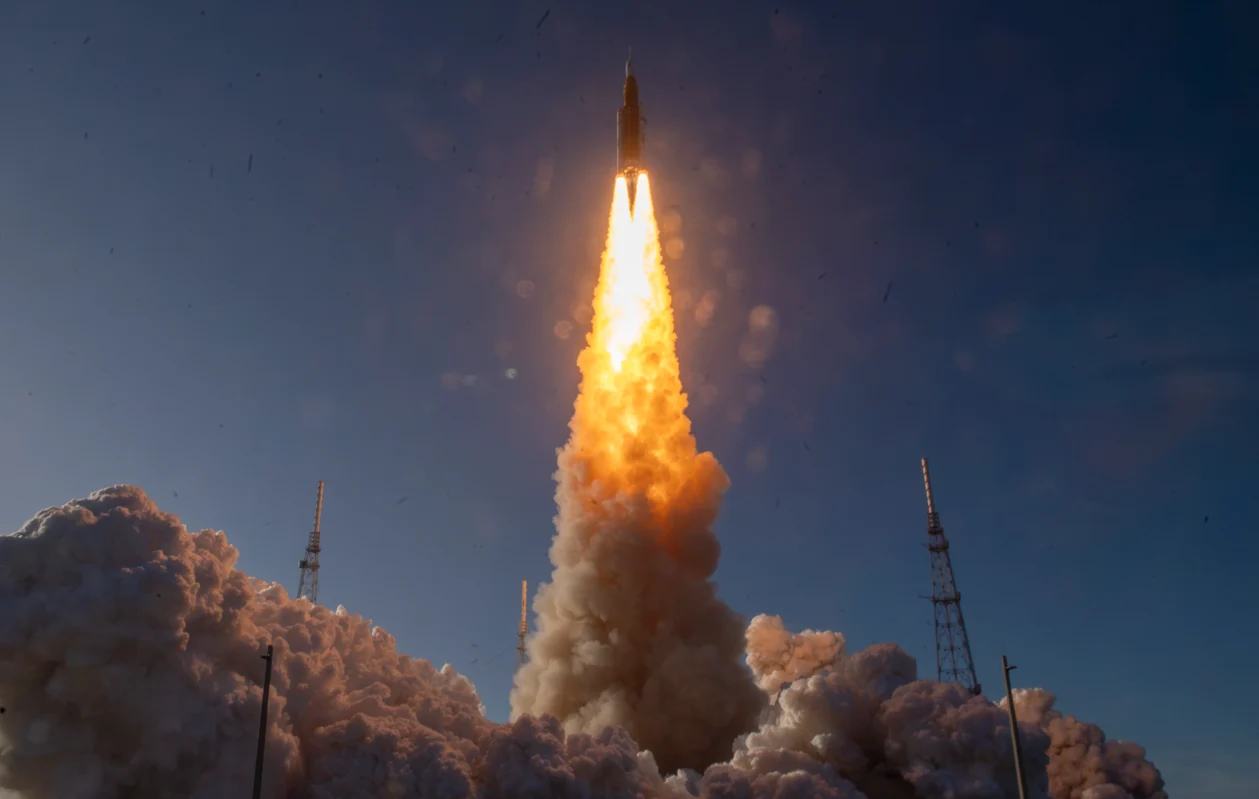
NASA’s Artemis II mission lifted off from Kennedy Space Center in Cape Canaveral, Florida, on April 1, 2026, marking the first crewed lunar flyby in more than 50 years. Four astronauts—three Americans and one Canadian—blasted off aboard the Space Launch System (SLS) rocket at 6:35 p.m. local time, beginning a 10-day journey around the Moon.
The Orion capsule’s powerful engine fired late Thursday, committing the crew to their trajectory toward the Moon. The six-minute burn was described by NASA as “flawless,” providing the thrust needed to place the spacecraft on a free-return path. This trajectory will use the Moon’s gravity to slingshot the crew around its far side before returning them to Earth without additional propulsion.
Astronaut Jeremy Hansen called the moment proof of humanity’s capabilities. Fellow crew members Reid Wiseman, Victor Glover, and Christina Koch shared their awe at the view of Earth and the Moon from space. Koch described the sight as breathtaking, noting the contrast of daylight on Earth and the Moon’s glow at night.
The astronauts reported minor issues during their first hours in space, including a communications glitch and a malfunctioning toilet. Koch humorously referred to herself as the “space plumber” after helping resolve the problem. The crew also began daily workouts on a flywheel exercise device to counteract muscle and bone loss in microgravity.
Though the spacecraft was chilly, the astronauts said they were adapting quickly, making Orion feel like home. They passed a floating microphone among themselves to answer questions from television networks, sharing their excitement with audiences back on Earth.
Artemis II is a critical step toward NASA’s plan to return humans to the lunar surface by 2028. The mission will test Orion’s systems with a crew onboard for the first time, paving the way for future landings. It also represents several historic milestones: the first woman, the first person of color, and the first non-American to participate in a lunar mission.
If successful, the crew could set a record by traveling farther from Earth than any humans before. Wiseman emphasized the magnitude of the mission, saying, “Sending four humans 250,000 miles away is a Herculean effort, and we are now just realising the gravity of that.”
Safety Measures
The astronauts are equipped with suits that double as survival systems. In the event of cabin depressurisation, the suits can maintain oxygen, temperature, and pressure for up to six days. NASA officials stressed that orbital mechanics will now carry the crew safely to the Moon and back.
The Artemis program aims to establish a permanent lunar base as a platform for deeper space exploration. The effort has been portrayed as part of a global competition, with China targeting its own crewed Moon landing by 2030.
NASA officials highlighted the mission’s symbolic importance. From orbit, Glover offered a message of unity, telling Americans, “You look amazing. You look beautiful. From up here, you also look like one thing. We’re all one people.”
The Artemis II mission is expected to demonstrate Orion’s capabilities and validate systems essential for future lunar landings. Success will build momentum toward Artemis III, which aims to place astronauts on the Moon’s surface.
For now, the crew continues its journey, documenting views of Earth and the Moon while testing the spacecraft’s systems. Their mission represents not only a technical achievement but also a symbolic return to lunar exploration after decades of absence.