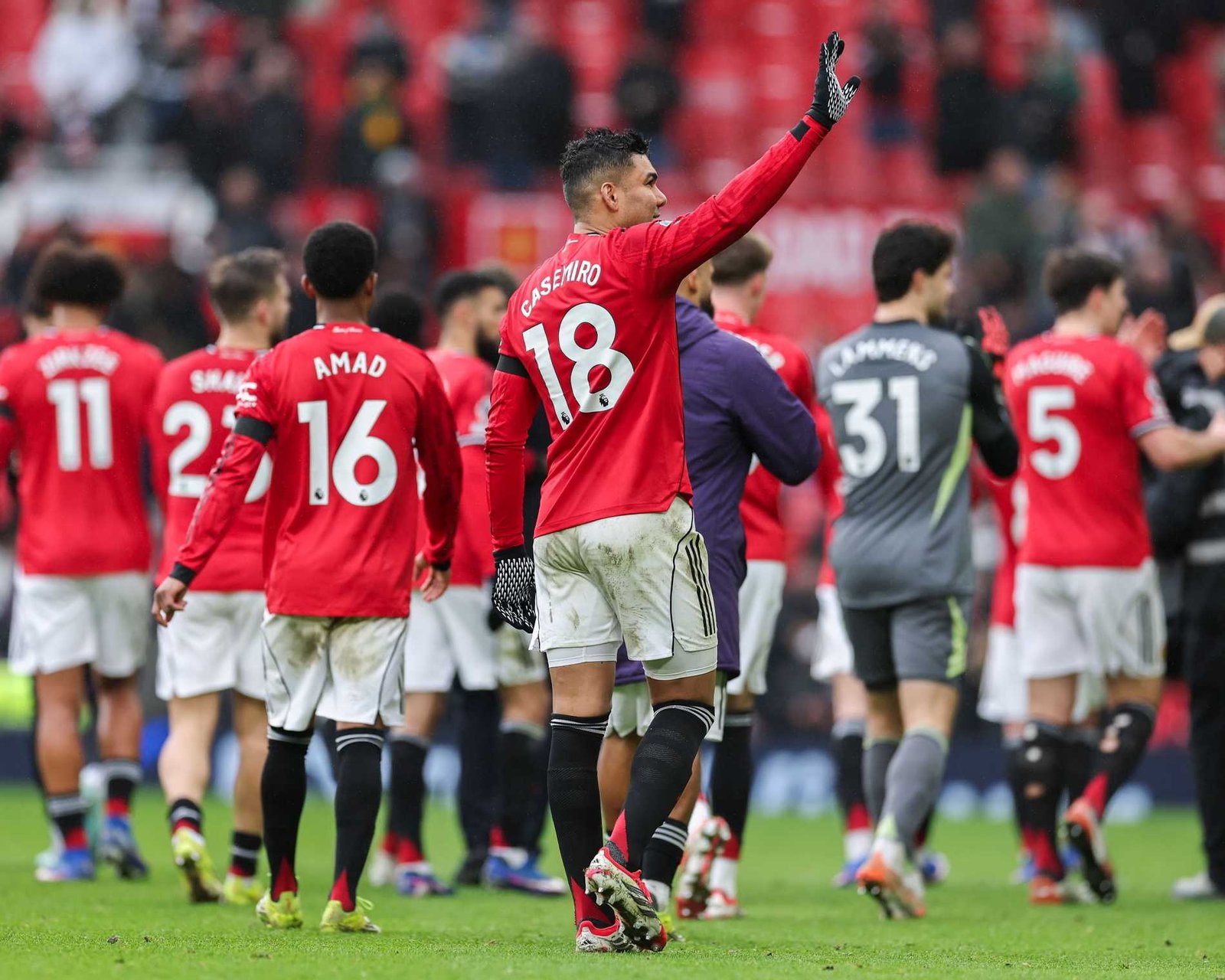
When Jamie Carragher quipped, “Leave the football before the football leaves you,” many assumed Casemiro’s decline was inevitable. Two years on, the Brazilian has proved those doubters wrong, bowing out of Manchester United on his own terms. At 34, he departs not as a fading star but as a player who adapted, endured, and reminded the Premier League of his class. Now, United face the daunting task of replacing him.
Casemiro’s struggles in 2024 were well documented. A 4-0 defeat to Crystal Palace left him exposed, bypassed by younger legs and Erik ten Hag’s high-risk system. Many thought the Saudi Pro League beckoned. Instead, Casemiro recalibrated his game. He sat deeper, relied on his anticipation, and timed tackles with precision. His aerial dominance remained intact, and he became the stabilizing presence United needed. Managers did not always build the perfect midfield around him, but Casemiro carried on with quiet authority.

Replacing that presence will be United’s biggest challenge this summer. His departure frees up significant wages, but the club must invest heavily to rebuild the midfield. After spending £200m in 2025 on attacking reinforcements like Matheus Cunha, Bryan Mbeumo, and Benjamin Sesko, attention now turns to the engine room. Of the current crop, only Kobbie Mainoo looks certain to stay. Bruno Fernandes continues to attract Saudi interest, while Manuel Ugarte’s struggles could see him moved on. United may need two or three midfield signings, with a defensive pivot at the top of the list.
Carlos Baleba is one option. Brighton’s valuation north of £100m deterred United last summer, but the Cameroonian has since reaffirmed his reputation as one of the league’s brightest young talents. At 22, his defensive instincts and physicality make him a natural successor to Casemiro. Elliot Anderson of Nottingham Forest is another candidate. The 23-year-old has impressed for club and country, offering energy and progressive passing. Forest, however, will demand a premium fee. Adam Wharton of Crystal Palace could also be in play, especially given Palace’s recent willingness to cash in on stars. His distribution and risk-taking in possession make him intriguing, though he may require a destroyer alongside him to balance the midfield.

Other names include Rúben Neves, who could return from Saudi Arabia, and Stuttgart’s Angelo Stiller, though both raise questions about fit and experience. Bournemouth’s Tyler Adams and Alex Scott tick United’s age and profile boxes but may not excite fans. Ultimately, much depends on who takes charge permanently. Michael Carrick has favored a 4-2-3-1 with Mainoo and Casemiro, but a new manager could demand a different balance.
Casemiro’s exit is more than the loss of a player; it is the loss of a leader who brought calm and steel to United’s midfield. His ability to adapt late in his career ensured he left with dignity, not decline. For United, the challenge is clear: find not just a replacement, but a midfielder who can anchor the team through its next era. The search will define their summer, and perhaps their trajectory for years to come.