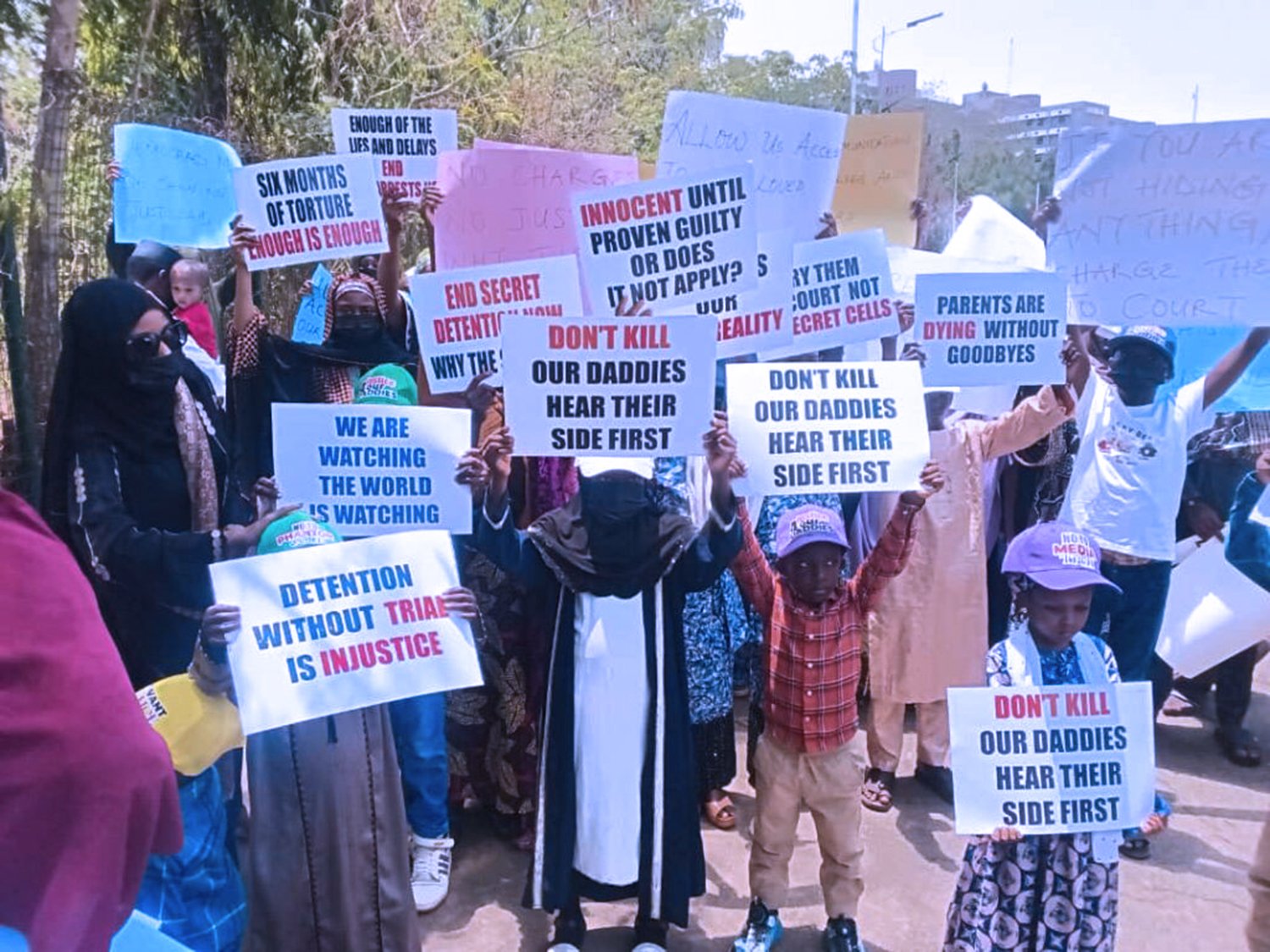
Families of Nigerian military officers detained over an alleged coup plot staged a peaceful protest at the National Assembly on Wednesday, demanding justice, transparency, and a speedy trial for their loved ones. The demonstration, led by wives and children of the accused, highlighted growing frustration over prolonged detention without trial.
The protesters, visibly distressed, carried placards with messages such as “Don’t Kill Our Daddies,” “Detention Without Trial is Injustice,” and “Six Months of Torture: Enough Is Enough.” Their slow procession at the entrance of the National Assembly drew attention to the emotional toll the arrests had taken on households.
Children of the detained officers spoke to journalists, delivering heartfelt appeals. Eight-year-old Halima Mohammed, daughter of Lieutenant Colonel Mohammed Almakura, pleaded for her father’s release, saying her family’s life had been shattered since his arrest. Nine-year-old Ibrahim Bala, son of Major Bala, recalled how his father used to guide him in schoolwork and lamented the loneliness at home. Four-year-old Fatima Yusuf begged the President and First Lady to intervene, while 11-year-old Nana Aisha Usman urged authorities to either release her father or charge him in court, insisting he was not a bad person.
Spouses also voiced their concerns. Nana Ibrahim described the coup allegations as suspicious, questioning why investigations had dragged on for over six months without access to families or lawyers. She demanded an open trial where charges could be heard publicly and the accused given a chance to defend themselves.
This protest follows earlier appeals made in March, when families of the detained officers held a press briefing in Abuja. Supported by human rights lawyer Deji Adeyanju and activist Omoyele Sowore, they accused the government of violating fundamental rights by holding the officers for over 160 days without trial. Memuna Bashiru, speaking on behalf of the families, said the prolonged detention had thrown households into uncertainty and emotional distress.
The arrests were first announced on October 4, 2025, by Brigadier General Tukur Gusau, then Director of Defence Information. Sixteen officers were taken into custody for alleged breaches of military regulations and acts of indiscipline. Subsequent investigations pointed to a clandestine network of officers accused of planning a coup. Reports claimed surveillance had been conducted on key national assets, including the Presidential Villa, Armed Forces Complex, Niger Barracks, and major airports, with October 25, 2025, cited as the intended date for the operation.
Those reportedly detained include Brig Gen M. A. Sadiq, Col M. A. Maaji, Lt Col S. Bappah, Lt Col A. A. Hayatu, Lt Col P. Dangnap, Lt Col M. Almakura, Maj A. J. Ibrahim, Maj M. M. Jiddah, Maj M. A. Usman, Maj D. Yusuf, Capt I. Bello, Capt A. A. Yusuf, Lt S. S. Felix, Lt Cdr D. B. Abdullahi, Sqn Ldr S. B. Adamu, and Maj I. Dauda. The alleged plot reportedly targeted senior government officials, including President Bola Tinubu and Vice President Kashim Shettima.
Despite these claims, families insist the government has failed to provide evidence or move the case to trial. They argue that continued detention without charges undermines constitutional rights and erodes trust in the justice system. The emotional testimonies of children at the protest underscored the human cost of the prolonged process, with many describing loneliness, disrupted education, and emotional trauma.
The families’ demands are clear: transparency, access to their loved ones, and adherence to due process. They want the government to either present evidence in court or release the officers. Their appeal to President Tinubu and First Lady Oluremi Tinubu reflects desperation for intervention at the highest level.
The protest adds pressure on authorities to clarify the status of the investigation and the fate of the detained officers. It also raises broader questions about accountability in military justice and the balance between national security concerns and fundamental rights.
As the case drags on, public attention is shifting from the alleged coup plot itself to the government’s handling of the matter. For the families, the issue is no longer just about allegations but about justice, transparency, and the right to fair trial. Their voices, amplified by the presence of children, have turned the spotlight on the human dimension of a case that has remained shrouded in secrecy for months.