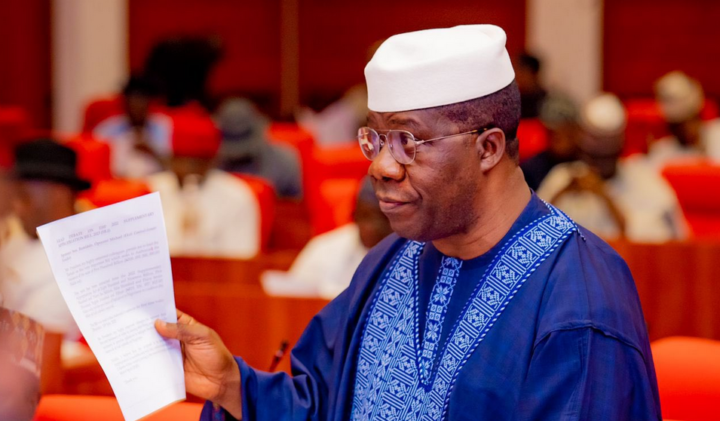
The Senate Leader, Opeyemi Bamidele, has said Nigeria lacks the capacity to enforce compulsory real-time electronic transmission of election results at the moment due to weaknesses in communication networks and electricity supply.
Bamidele made this position known in a statement released on Sunday through his Directorate of Media and Public Affairs. He explained that existing data indicates that the country’s infrastructure cannot sustain nationwide real-time transmission of results.
The Senate had earlier rejected clause 60(3) of the Electoral Bill 2026. The provision states that the presiding officer “shall electronically transmit the results from each polling unit to INEC Result Viewing Portal (IReV) in real time”.
After reviewing the clause, lawmakers retained electronic transmission. However, they added a condition that Form EC8A would serve as the primary means of collating results wherever internet connectivity fails.
Bamidele noted that clause 60(3) of the bill “is an initiative that any legislature or parliament globally will have embraced ordinarily”.
He cited statistics from the Nigerian Communications Commission, which show that broadband coverage stood at about 70 per cent in 2025, while internet penetration reached 44.53 per cent of the population.
He also referred to the Speedtest Global Index rankings. According to him, Nigeria placed 85th out of 105 countries in mobile network reliability and 129th out of 150 countries in fixed broadband reliability.
“Based on the Speedtest Global Index, Nigeria’s mobile network reliability was 44.14 megabits per second,” he said.
“This is extremely low compared with the UAE, which has 691.76 Mbps; Qatar with 573.53 Mbps; Kuwait’s 415.67 Mbps; Bahrain’s 303.21 Mbps; and Bulgaria’s 289.41 Mbps. The Index placed Nigeria far below the global average.
“Nigeria’s fixed internet broadband rating is quite low by the global standard. Out of 150 countries, Nigeria occupied 129th position with only 33.32 Mbps.”
The Senate Leader also raised concerns about electricity supply. He said about 85 million Nigerians do not have access to grid power, which represents roughly 43 per cent of the population.
“This shortfall speaks to the state of our power infrastructure,” he said.