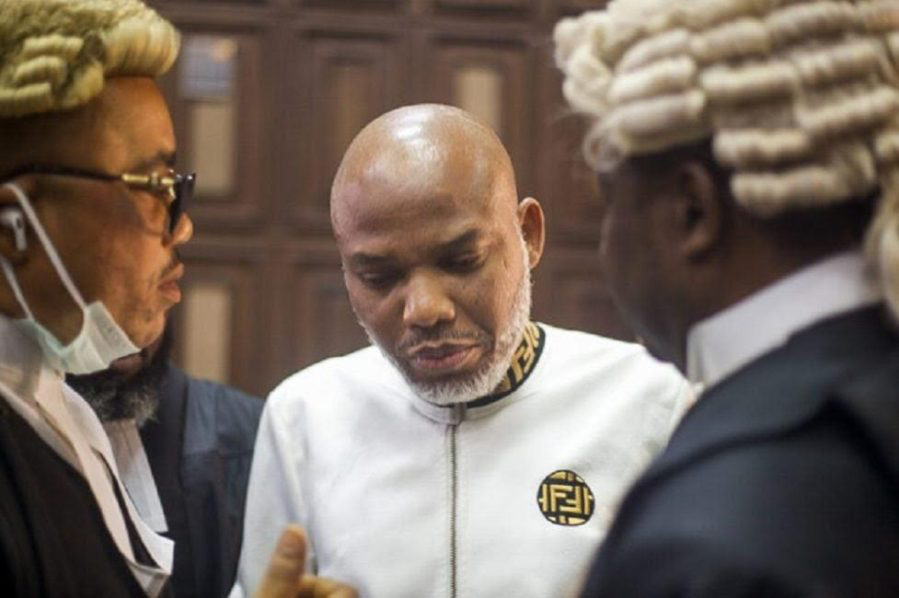
Nnamdi Kanu, the leader of the Indigenous People of Biafra (IPOB), has filed a 22-point appeal against his life sentence, challenging the Federal High Court’s November 20, 2025 ruling that convicted him on terrorism-related charges.
Kanu was convicted on a seven-count terrorism charge brought by the Federal Government and sentenced to life imprisonment. In the notice of appeal, which he personally signed, Kanu argued that the trial judge, Justice James Omotosho, made legal errors and that the trial resulted in a grave miscarriage of justice.
One of Kanu’s primary complaints is that the trial court failed to address the legal consequences of disruptions to his earlier trial following a September 2017 military operation called Operation Python Dance II. He said his home in Afara-Ukwu was raided by state agents during the operation, causing deaths, destruction, and halting the original trial process.
“The said operation resulted in deaths and destruction and triggered disruption of the earlier proceedings,” Kanu said. He argued that the trial court should have first determined the effect of that disruption on the competence of the case before hearing evidence and delivering judgment.
Kanu also contended that the trial judge erred by proceeding with the trial and judgment without hearing and determining his preliminary objection on jurisdictional grounds. “The Learned Trial Judge did not hear or determine the objection. The court proceeded with evidence and delivered judgment while the objection remained pending and undetermined,” he said.
Another key ground of appeal is that the court convicted him while his bail application was still pending, which Kanu said undermined the fairness of the trial.
He further faulted the sentencing process, stating that the court imposed the life sentence without allowing him to give allocutus — the opportunity for a convicted person to address the court in mitigation. “Sentence was imposed without allocutus. The court did not consider relevant mitigation or sentencing factors,” he argued, describing the life sentence as excessive and unlawful.
In his appeal, Kanu asked the Court of Appeal to:
* Quash his conviction on all counts in charge FHC/ABJ/CR/383/2015;
* Set aside the sentences imposed by the Federal High Court; and
* Discharge and acquit him on all counts.
Kanu also informed the appellate court of his intention to be physically present during the hearing of the appeal, stating that he wants to present his case and arguments both in writing and orally, and may conduct the appeal in person.