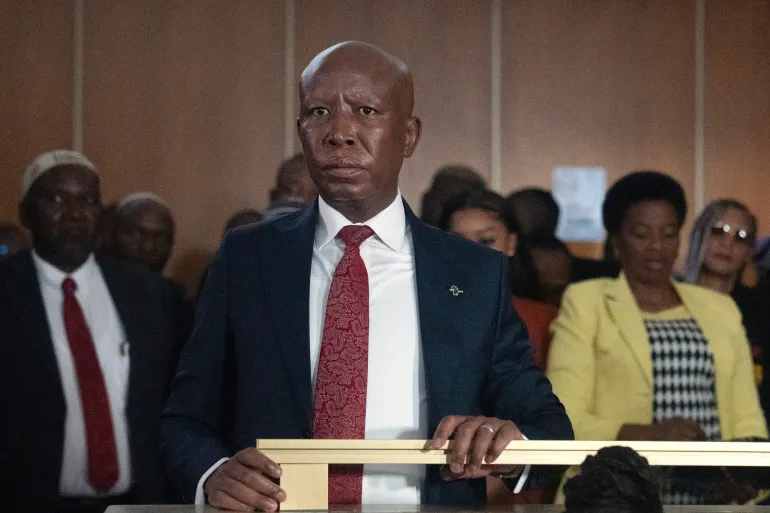
The conviction and sentencing of Julius Malema, leader of South Africa’s Economic Freedom Fighters (EFF), has ignited a national debate that extends beyond the courtroom. Malema, a prominent opposition figure known for his radical rhetoric, was sentenced to five years in prison for firing an assault rifle during a political rally in 2018. The ruling has triggered widespread reactions, highlighting tensions between the rule of law, political expression, and public security.
Magistrate Twanet Olivier delivered the judgment in KuGompo, formerly East London, stressing that Malema’s actions were deliberate and not impulsive. She described the gunfire as a planned part of the rally, underscoring that the violation of firearm laws was intentional. The state had sought a 15-year sentence, but the court imposed five years, a penalty still severe enough to remove Malema from parliament.
Malema’s defence argued that the shots were celebratory and not intended to cause harm. His legal team announced plans to appeal both the conviction and the sentence, framing the case as politically motivated.
The sentencing drew large crowds of EFF supporters clad in red, who gathered outside the court and in major cities such as Johannesburg to watch the proceedings live. The party, which won under 10 percent of votes in the 2024 general elections and holds 39 parliamentary seats, has positioned the case as an attempt to silence its leader.
Party members and activists warned of protests if Malema is jailed, emphasizing his role as a symbol of resistance against inequality and entrenched power structures.
The case was initiated by AfriForum, a conservative Afrikaner lobby group that has long clashed with Malema. AfriForum has criticized him for using the controversial chant “Kill the Boer” at rallies, arguing it incites violence against white South Africans. Courts have rejected these claims, ruling that the chant, while provocative, does not constitute hate speech when considered in the historical context of anti-apartheid struggle.
AfriForum has also sought international attention for its disputes with Malema, even raising the issue with former U.S. President Donald Trump, who questioned South African President Cyril Ramaphosa about Malema’s rhetoric during a White House meeting.
The sentencing was welcomed by the Democratic Alliance (DA), South Africa’s second-largest party. DA leader Geordin Hill-Lewis emphasized the importance of strict enforcement of firearm laws, noting that gun violence remains a serious problem in the country. He argued that Malema’s case demonstrates the need for accountability, regardless of political status.
This response reflects broader concerns about public safety. Illegal gun use has contributed to rising crime rates, and the DA insists that harsh penalties are necessary to deter violations.
Malema’s imprisonment, if upheld, carries significant political consequences. Losing his parliamentary seat would weaken the EFF’s influence, though the party’s vocal base may intensify activism outside formal institutions. Analysts suggest that the case could either diminish Malema’s political career or galvanize his supporters, depending on how the appeal process unfolds.
The controversy also raises questions about the balance between political expression and legal responsibility. While Malema’s supporters view the case as suppression of dissent, critics argue that leaders must be held accountable when their actions undermine public safety.
Julius Malema’s sentencing is more than a legal matter; it is a moment that encapsulates South Africa’s ongoing struggle with political radicalism, public safety, and democratic accountability. The case has mobilized supporters, emboldened critics, and placed the judiciary at the center of a national debate. Whether Malema’s appeal succeeds or fails, the controversy will continue to shape discussions about the role of opposition politics, the enforcement of firearm laws, and the resilience of South Africa’s democratic institutions.