Russian missile and drone strikes killed at least 18 people across Ukraine on Tuesday, intensifying the conflict just days before Moscow’s annual May 9 Victory Day parade. Ukrainian President Volodymyr Zelenskyy denounced the attacks as “utter cynicism,” accusing Russia of seeking a ceasefire for propaganda purposes while continuing to bombard Ukrainian cities.
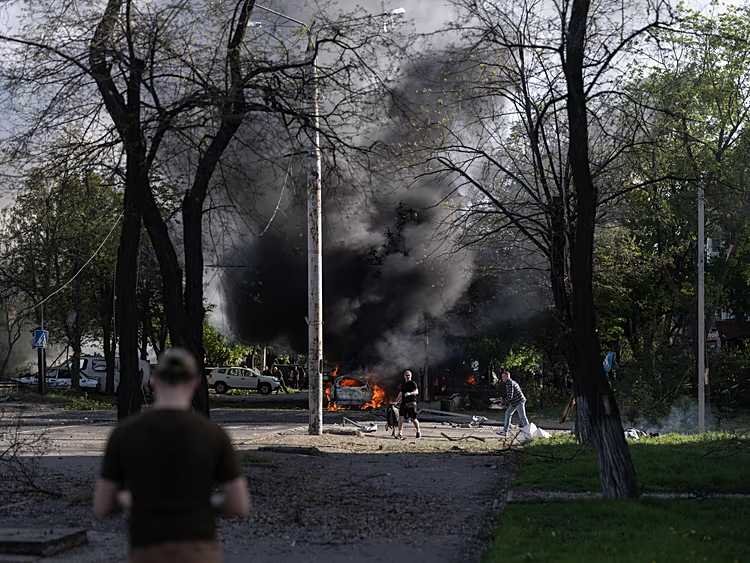
Local officials reported that twelve people died in Zaporizhzhia after a Russian airstrike struck the southern city. Governor Ivan Federov confirmed the casualties and warned that rescue operations were still underway. In Kramatorsk, the last major city under Kyiv’s control in the Donetsk region, Russian forces targeted the city center. Zelenskyy said at least five civilians were killed and cautioned that the death toll could rise as emergency crews comb through the wreckage. “The attack hit right in the city centre, targeting civilians,” he stated.
The timing of the strikes drew sharp criticism from Kyiv. On Monday, Moscow announced plans for a ceasefire during its May 9 celebrations, which commemorate the Soviet Union’s victory over Nazi Germany in World War II. Kyiv had earlier declared its own symbolic ceasefire for May 6. Zelenskyy dismissed Russia’s announcement as hollow, arguing that Moscow could end hostilities at any time if it truly wanted peace. “It is utter cynicism to ask for a ceasefire to hold propaganda celebrations while carrying out missile and drone strikes every single day leading up to it,” he said. “Russia could cease fire at any moment, and this would stop the war and our responses.”
Victory Day parades traditionally showcase Russia’s military might, but this year the Kremlin ordered a scaled-back event. No military hardware will be displayed, reportedly out of concern that Ukrainian forces could target the spectacle. Ever since 2022, Moscow has attempted to draw a connection between its aggression against Ukraine and the Soviet Union’s victory over Nazi Germany; it has even described the war as an echo of the age-old battle between good and evil. Zelenskyy rejected that narrative, calling the celebrations a cover for ongoing aggression.
Russia also reported casualties from Ukrainian retaliation. Officials in Cheboksary, a city on the Volga River hundreds of kilometers from Ukraine, said a Ukrainian drone strike killed two people and injured 32 others when it slammed into an apartment block. Regional authorities described the attack as part of Kyiv’s intensifying campaign of long-range strikes. In recent weeks, Ukraine has hit Russian oil facilities and even a luxury high-rise in Moscow, calling these operations fair retaliation for Russia’s nightly bombardments of Ukrainian cities.
The violence extended to Ukraine’s central Poltava region, where a Russian strike killed four people overnight. Among the dead were employees of state energy company Naftogaz and two first responders. Ukraine’s Foreign Minister Andrii Sybiha condemned the attack, describing it as a “vile double-tap strike” that deliberately targeted rescuers who had arrived to help victims of an earlier drone hit. The state emergency service confirmed that Russia fired four missiles at the site after the initial drone strike, releasing footage of a massive fireball erupting at the facility. Sybiha described Moscow as using “criminal means” aimed at “the most prolonged agony” of the civilian population.
The increased bombardments underscore how both sides anticipate what is becoming a bloody confrontation centered around several symbolic dates. The strikes make clear Ukraine’s resolve not to suspend hostilities, even as Russia called for a temporary cessation of fire for national celebrations. From the Russian side, there have now started to be drones hitting deep inside Russian territory, showing increasing capabilities from the Ukraine side.
Zelenskyy in his speech, made it known that his frustration was mounting with his perception that Russia could successfully marry brutality and patriotism. By dismissing Russia’s proposed ceasefire as a trick, he tried to point to what he saw as an inconsistency between celebrating peace and victory while also prosecuting a brutal war. His statements signaled Ukraine’s intent not to buckle and to maintain international focus on the war’s human toll.
The hits in Zaporizhzhia, Kramatorsk, and Poltava add to Ukraine’s growing civilian death toll, while the drone strike in Cheboksary represents the widening battlefield. Each side accuses the other of targeting civilians, with each stating that they are merely responding to the other’s aggression, but neither has managed to break the escalating cycle of violence.
As Moscow looks to its May 9 parade, the clash between festive pomp and wartime devastation could not be starker. For Ukrainians, the date remains a symbol of struggle, resistance, and survival; for Russians, it appears to be a sign of both a public order crackdown and a war of attrition that is lasting far longer than they hoped.
The recent rounds of strikes seem to confirm what both sides already appear to be believing – that this war has far more life in it despite talk of ceasefires. While both sides maintain they are responding to the other’s actions, the civilian population has already begun to pay the high price for their national leaders’ inability to do anything else.