Many of America’s top CEOs are headed to Beijing this week, but not for a tech conference. They are travelling with the president aboard Air Force One.
President Donald Trump has brought more than a dozen executives on his first state visit to China in nearly a decade, indicating that business interests will remain a central part of his strategy when he meets with Chinese leader Xi Jinping.
The Flight
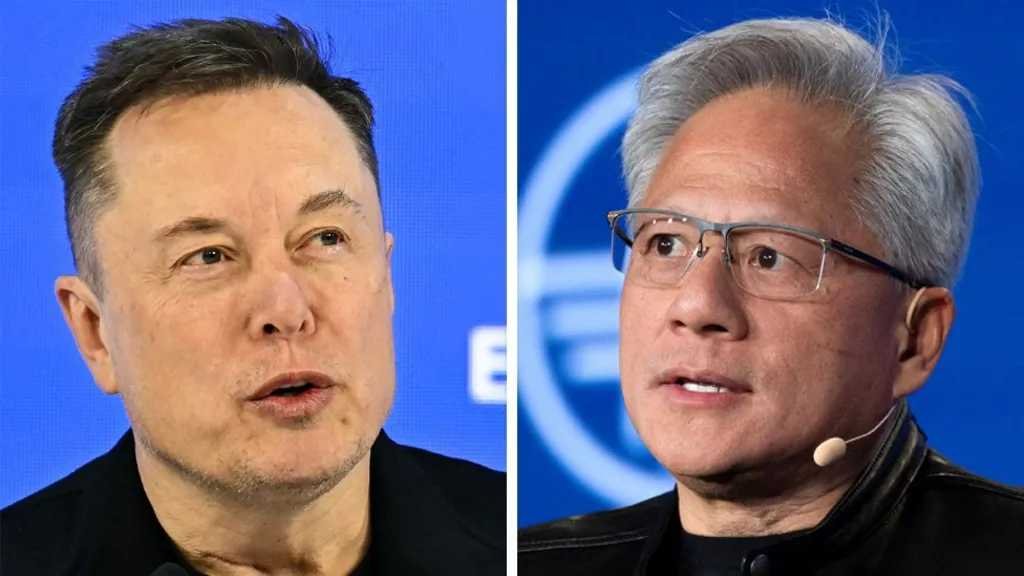
The attendees list reads like an index of the American corporate elite. Among them are Tim Cook of Apple, CEO of Tesla and SpaceX Elon Musk, BlackRock CEO Larry Fink, and representatives from Goldman Sachs, JPMorgan Chase, Boeing, Visa, Mastercard, Citi, Cargill, Meta and GE Aerospace.
Most notable among the group, however, was Nvidia’s Jensen Huang, who wasn’t initially scheduled to attend. Trump reportedly called him directly to extend an invitation Tuesday morning, after the omission came to light. Huang boarded Air Force One during its refueling stop in Anchorage, Alaska, becoming the latest high-profile addition to a delegation that was already weighty with significance.
“Jensen is attending the summit at the invitation of President Trump to support America and the administration’s goals,” Nvidia said in a statement confirming Huang’s attendance.
Trump took to Twitter on Tuesday to dismiss reports that Huang had been excluded: “Jensen is currently on Air Force One and, unless I ask him to leave, which is highly unlikely, CNBC’s reporting is incorrect.”
Why Huang’s Presence is Significant
Of all the execs accompanying Trump, Huang’s attendance carries the sharpest geopolitical resonance. His company’s AI chips are at the core of the technological competition between the US and China. The sale of advanced semiconductors to China is one of the most contentious issues in the US-China relationship, and Huang is a member of Trump’s Council of Advisors on Science and Technology, a position he also holds alongside Meta’s Mark Zuckerberg and Oracle’s Larry Ellison.
Micron Technology’s CEO, Sanjay Mehrotra, is also a participant. China banned Micron’s chips from its critical infrastructure last year over national security concerns, leading to a significant decline in the company’s Chinese revenues. His presence in Beijing, under such circumstances, has its own pointed symbolism.
Beyond the Boardroom: What’s at Stake
This is the first visit by a sitting US president to China in roughly ten years, and it comes at a particularly tense moment. A trade war has pushed tariffs well above 100 percent on each side, and this summit is largely seen as a test of the fragile truce that was reached in October after Trump and Xi’s meeting in South Korea.
Completely overshadowing the economic agenda, however, is the ongoing conflict between the US and Iran that has already postponed the meeting by 24 hours. Trump is expected to call on Beijing to help broker a peace deal with Iran, a conflict that China has no interest in seeing escalate further given its dependence on discounted Iranian oil, its energy imports and the negative impact of the conflict on the spending power of its major trading partners.
The country has already acted quietly to reduce its reliance on oil imports from Iran, but given its vast reserves and the fact that it has access to a diversified energy portfolio, China will not feel the pressure to make hasty concessions.
The Symbolism of the Delegation
The executives accompanying Trump span sectors including social media, consumer technology, AI, financial services, aerospace, and agribusiness, representing a deliberately diverse array of American economic might.
Chuck Robbins, the CEO of Cisco, had also been invited but had to skip the trip to attend an earnings call; even presidential requests are not always enough to pull a CEO away.
The business objectives of the companies that are travelling have implications beyond simply securing favorable publicity. China is one of the most important markets for nearly every company on the list, and direct access to Xi’s government at this critical juncture in the relationship is an opportunity few leaders in the corporate world would willingly pass up.