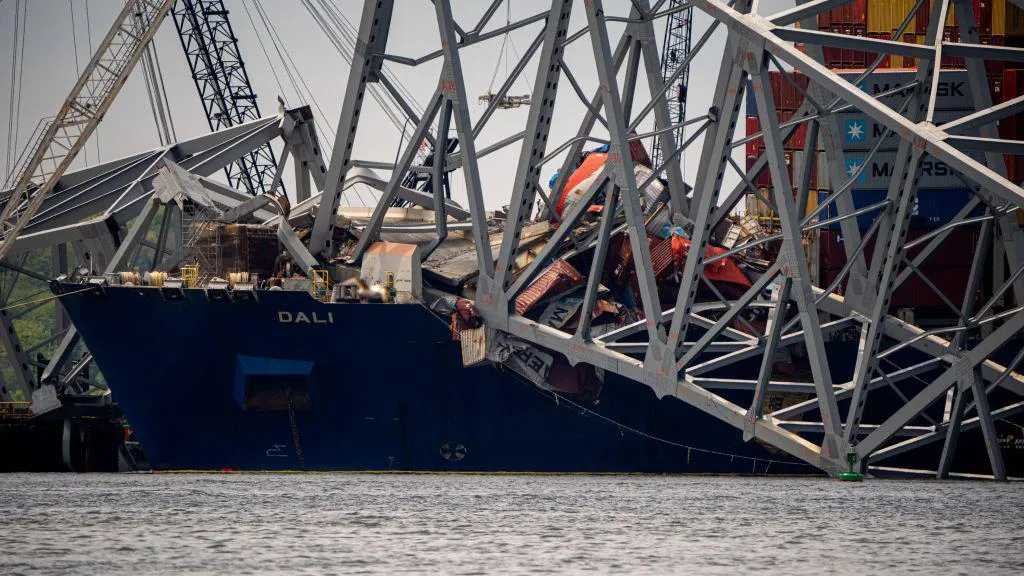
Federal prosecutors have charged the owner of the cargo ship Dali two years after it struck Baltimore’s Key Bridge, leading to the bridge’s collapse and the deaths of six people.
Synergy Marine, the company operating the ship, along with one of its employees, faces charges including conspiracy, obstruction, and misconduct resulting in death.
Prosecutors allege that Synergy Marine misled investigators about conditions on the ship and failed to inform the US Coast Guard about hazards and safety concerns.
A spokesperson for Synergy stated that the company “will defend against these allegations with vigor.”
Adding that “the DOJ is criminalizing a tragic accident. The allegations in the indictment are baseless and have nothing to do with the Dali’s allision with the Francis Scott Key Bridge.”
Acting Attorney General Todd Blanche remarked that the bridge collapse was “a preventable tragedy of enormous consequence.”
Emphasizing that the indictment is an essential step in holding accountable those whose reckless disregard for maritime safety regulations led to this disaster.
The indictment, unsealed on Tuesday, pertains to the company’s operations based in Singapore and India. Dali’s technical supervisor, Radhakrishnan Karthik Nair, also faces criminal charges.
In the early hours of March 26, the M/V Dali container ship collided with the landmark Francis Scott Key Bridge, causing several vehicles on the bridge to plunge into the river and resulting in the deaths of six construction workers.
The incident also led to significant economic disruption as shipping operations were halted.
The city is currently working on reconstructing the bridge, a process expected to take years and cost billions of dollars.
The National Transportation Safety Board has identified several contributing factors, including a loss of electrical power from a faulty cable, issues with a fuel pump on the ship, and inadequate countermeasures to protect the bridge’s integrity.
According to court filings, prosecutors indicated that the Dali struck the bridge after experiencing two power
outages within four minutes. The first outage was attributed to a loose wire in a switchboard, while the second occurred because the crew depended on a flushing pump to supply fuel to two of the ship’s generators.
Prosecutors stated that using the flushing pump was unauthorized, as it was not designed to automatically restart after a blackout.
They contended that if the crew had used the proper fuel supply, the vessel would have regained power before colliding with the
bridge. In response, Synergy argued that the flushing pump’s use was “wholly irrelevant to the cause” of the crash.
The indictment also alleges that Synergy employees were aware of the improper usage of the flushing pump and “took steps to hide the use” on the Dali and other
vessels, and that the company falsified safety records.
In a separate civil case, Maryland Attorney General Anthony Brown announced a $2.25 billion settlement with Synergy Marine related to the bridge collapse.
This settlement resolves a lawsuit filed by the state in 2024 for damages associated with the bridge’s destruction, environmental harm, lost toll revenues, and other economic losses for Maryland and its residents.
The vessel’s owner has already paid over $100 million to the Justice Department to settle a civil claim regarding the damages to the bridge, as well as $350 million to Maryland’s insurance company.