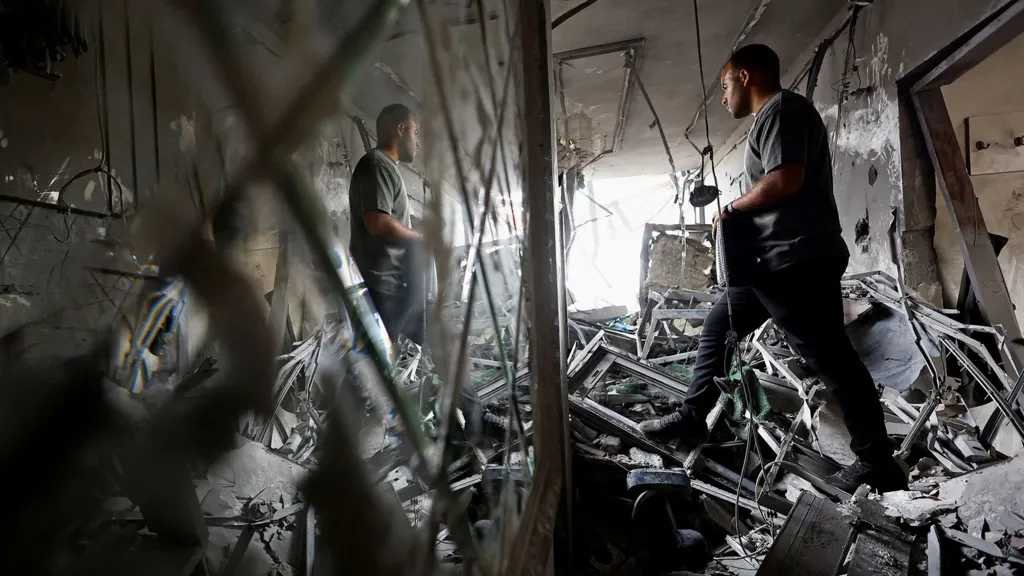
Israeli forces have killed Mohammed Odeh, the newly appointed head of Hamas’s military wing, in a targeted strike on Gaza City. The attack, carried out Tuesday evening, struck a residential building in one of the city’s busiest market districts, leaving dozens injured and several dead, including Odeh’s wife and two of his children.
The strike comes just days after Odeh’s predecessor, Izz ad-Din al-Haddad, was killed in a similar operation. Odeh had only recently assumed leadership of the Izzedine al-Qassam Brigades, Hamas’s armed wing, following Haddad’s death.
Targeted Operation
Israel’s military and Shin Bet security service confirmed the operation, stating that Odeh had been under surveillance for months. Intelligence reports tracked his movements and identified hideouts in central Gaza City. According to the statement, multiple missiles hit the al-Kayali building almost simultaneously, collapsing its upper floors.
Witnesses reported hearing helicopters overhead before the strikes. Rescue teams rushed to the site but struggled to reach trapped victims due to heavy damage and crowded streets. Footage showed ambulances and civil defence crews pulling survivors from the rubble as residents gathered nearby.
Family Casualties
Hamas confirmed Odeh’s death on Wednesday, along with his wife and two children. One child succumbed to injuries in hospital hours later. The family was buried after noon prayers at a mosque in Gaza City.
The timing of the strike, just days before Eid al-Adha, added to the chaos in the city’s market district, where shoppers had filled the streets.
Israeli Justification
Prime Minister Benjamin Netanyahu’s office described Odeh as “one of the architects of the October 7 massacre,” accusing him of planning attacks that killed and abducted Israeli civilians and soldiers. Netanyahu vowed that Israel would continue pursuing anyone involved in the October 7 assault, declaring, “Sooner or later, Israel will reach them all.”
Israeli Defence Minister Israel Katz reinforced the government’s stance, saying Israel would prevent Hamas from governing Gaza “either civilly or militarily.” He also referenced plans for “voluntary emigration from Gaza,” though no timeline was provided.
Hamas Response
Hamas accused Israel of violating the ceasefire agreement reached in October. The group claims Israel has repeatedly targeted civilians during ongoing strikes. Gaza’s Hamas-run health ministry reported more than 900 deaths from Israeli attacks since the ceasefire began.
Despite the truce, Israel insists it retains the right to strike Hamas operatives. Officials argue that Hamas has breached the agreement by refusing to disarm and by reactivating its police force.
Wider Conflict
The strike in Gaza follows escalating violence across the region. Israeli forces recently killed 31 people in Lebanon during operations against Hezbollah, targeting what they described as militant infrastructure. Netanyahu has pledged to intensify military action against Hezbollah, further widening the scope of Israel’s campaign.
The war in Gaza began after Hamas’s October 7 attack on southern Israel, which killed about 1,200 people and resulted in 251 hostages being taken. Israel’s response has devastated Gaza, with the health ministry reporting more than 72,800 deaths. The United Nations considers these figures credible.
Stalled Peace Efforts
A US-led peace plan for Gaza remains stalled. The initiative, announced in January, envisioned a transitional technocratic administration, demilitarisation, and reconstruction. However, talks on disarmament have collapsed, and Hamas appears to be reasserting control in the territory.
The deadlock has left Gaza’s 2.1 million residents in limbo, many displaced and living amid ruins. International pressure continues to mount for a resolution, but progress has been slow.
The killing of Mohammed Odeh marks another escalation in Israel’s campaign against Hamas leadership. With Odeh’s death, Israel has eliminated two successive commanders of Hamas’s armed wing in less than a month. The strike underscores Israel’s determination to dismantle Hamas’s military structure, even as civilian casualties rise and peace efforts falter.
The incident highlights the fragility of the ceasefire and the deepening humanitarian crisis in Gaza. As both sides trade accusations of violations, the prospect of lasting peace remains distant.