Arsenal’s resurgence under Mikel Arteta owes much to the unusual circumstances of the Covid-19 pandemic, according to club co-chair Josh Kroenke. He believes the behind-closed-doors era gave the manager vital space to reshape the team without the immediate pressure of fans inside stadiums.
Arteta, appointed in December 2019, inherited a club struggling to find direction after Arsène Wenger’s departure. His early years were marked by inconsistency, including two eighth-place finishes, despite winning the FA Cup in 2020. Many questioned whether he was the right man to lead Arsenal back to the top.
Kroenke admits the transition was turbulent. The Kroenke Sports and Entertainment group had taken full control of Arsenal in 2018, facing protests from supporters who doubted their commitment. The departure of chief executive Ivan Gazidis added to the instability. “Too much change in too short a period,” Kroenke reflected.
Yet the pandemic created an unusual environment. With matches played in empty stadiums, Arteta was able to experiment and implement his ideas without the constant scrutiny of fans. Kroenke now sees that period as a hidden advantage. “There were growing pains, but not having fans on top of you at every moment gave Mikel some breathing room,” he said.
The turning point came after Arsenal’s heavy defeat to Chelsea in the 2019 Europa League final. Kroenke recalls telling his father, Stan, that the club needed to “embrace where we are” and rebuild. That conversation led to a shift in strategy, focusing on youth and long-term development rather than quick fixes.
One of the most significant moves was the signing of William Saliba. Recommended by academy director Per Mertesacker, Saliba joined from Saint-Étienne in 2019 and has since become a cornerstone of Arsenal’s defence. Kroenke compared the search for talent to Liverpool’s acquisition of Virgil van Dijk, acknowledging Arsenal could not spend £100 million but needed to identify the best young prospects.
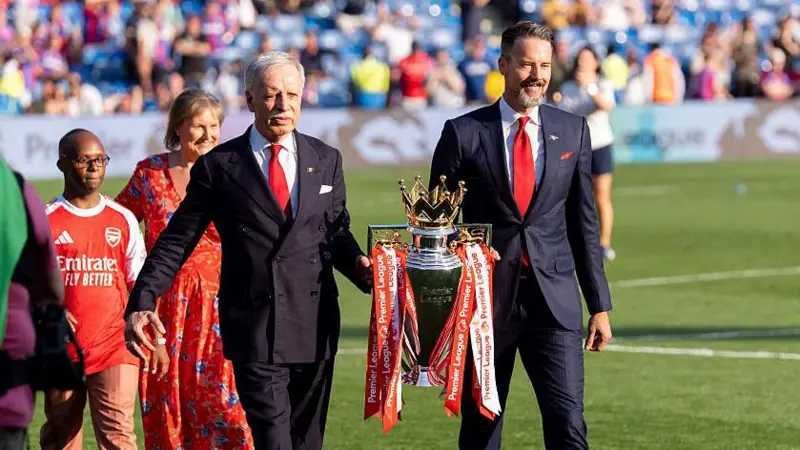
Arteta’s persistence eventually paid off. Six years after his appointment, Arsenal lifted their first Premier League title in 22 years. Kroenke described watching the decisive VAR decision against West Ham from his living room in the United States, admitting he was “on his hands and knees” as the goal was ruled out.
The victory sparked jubilant scenes at the Emirates, with thousands of fans celebrating the end of what Kroenke called the “Banter Era.” He believes Arsenal’s revival has reawakened a “sleeping giant,” one now thriving in the social media age.
But Kroenke insists success is only the beginning. With a Champions League final against Paris Saint-Germain looming, he stressed the need to keep evolving. “If you’re not trying to continually improve, you’re standing still,” he said. Arsenal plan to strengthen their squad this summer to remain competitive at the top.
For Kroenke, the journey reflects resilience through adversity. From fan protests and managerial uncertainty to pandemic-era rebuilding, Arsenal have emerged stronger. Arteta’s leadership, combined with strategic patience, has restored belief in North London.
The Covid-19 lockdown may have silenced stadiums, but it gave Arsenal the quiet space needed to rediscover their voice. Today, that voice echoes loudly across the Premier League.