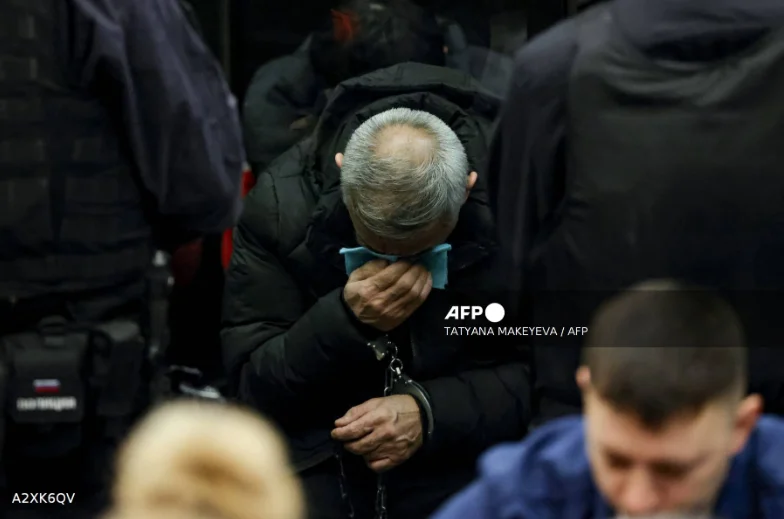
A Russian court on Thursday sentenced 15 men to life imprisonment for their roles in the 2024 attack on the Crocus City Hall concert venue in Moscow, which claimed the lives of about 150 people.
The verdict came from a grand military court in Moscow. Relatives of several victims of the March 22, 2024 assault attended the proceedings.
Four of the convicted men — Shamsidin Fariduni, Dalerdzhon Mirzoyev, Makhammadsobir Fayzov and Saidakrami Rachabolizoda — were identified as the gunmen who carried out the attack inside the concert hall. The men, all citizens of Tajikistan, opened fire on people in the building before they set the facility ablaze. The judge sentenced each of them to life in prison. Reports said the defendants looked down as the verdict was announced.
The court also imposed life sentences on 11 other men for aiding the attackers and for links to terrorism. Some of those convicted are Russian citizens.
In addition, four other suspects, including a father and his sons, received prison terms that range from 19 to 22 years because of their connections to the attackers.
Authorities described the incident as the worst attack in Russia since the 2004 Beslan school siege.
The attackers stormed the venue shortly before a performance by the Soviet-era rock band Picnic. They later set the building on fire. Many victims were trapped inside during the blaze. More than 600 people sustained injuries, while six children were among those killed.
The attack took place during the second year of Russia’s war in Ukraine. At the time, Russian officials had dismissed warnings from the United States about a possible imminent attack.
After the incident, the Kremlin suggested that Ukraine could have been involved. However, officials did not provide evidence to support the claim.
Following the verdict, Russia’s Investigative Committee stated that it had “reliably established” that the attack was “planned and committed in the interests of” Kyiv. The agency also said the suspects had planned other attacks in the Dagestan region.
The judgment came shortly before the second anniversary of the attack.
“For us all, it’s like yesterday,” Ivan Pomorin, who had been filming the Crocus Hall concert when the attack began, told AFP during the court session.
He also expressed doubt that all those responsible had been punished. “For us, the victims and relatives of the victims, it is not clear whether everyone has been brought to justice. It looks like these are not the people who could organise it. The investigative committee should continue its work,” he said.
The four gunmen were between 20 and 31 years old at the time of the attack. They had worked in various occupations such as taxi driving, factory work and construction.
During the court proceedings, they stood in a glass defendant’s cage under heavy security.
Media reports indicated that Mirzoyev’s brother had died while fighting in Syria, an experience that may have influenced his radicalisation.
The suspects appeared in court hours after the attack. Reports at the time said some of them showed signs of torture. One of the accused was brought in a wheelchair and appeared barely conscious. Videos circulated on social media also appeared to show violent interrogations allegedly carried out by security agents.
Earlier this month, the state news agency TASS reported that two suspects — Dzhabrail Aushyev and Khusein Medov — had asked the court to allow them to fight in Ukraine instead of serving life sentences.
Russia has recruited prisoners to join its military campaign during the war. Some inmates receive reduced sentences if they survive combat.
According to the lawyer cited by TASS, Medov said he wanted to “redeem his guilt with blood.”
Prosecutors also asked the court to strip relatives of one of the gunmen of their Russian citizenship.
After the Crocus attack, Russian authorities tightened migration rules and adopted stronger rhetoric against migrant communities. The measures strained relations with some Central Asian countries, whose governments urged Moscow to respect the rights of their citizens.
Russia’s economy has relied heavily on migrant workers from Central Asia for many years. Migration to the country declined after the start of the war in Ukraine. The numbers fell further after the crackdown that followed the Crocus concert hall attack.
AFP