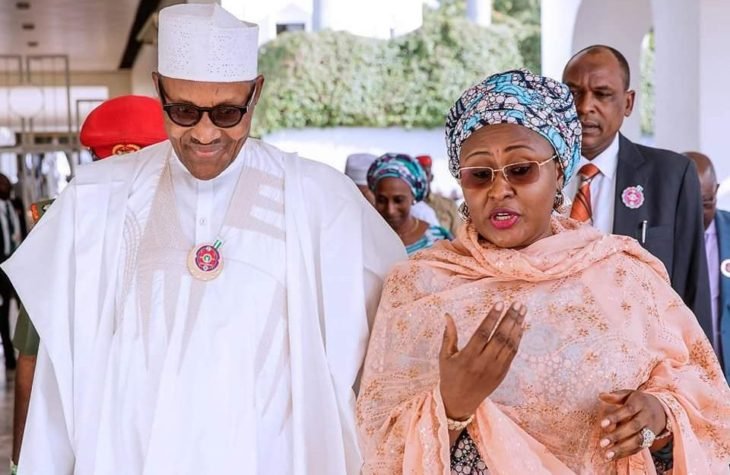
Former First Lady Aisha Buhari has disclosed that her late husband, ex-President Muhammadu Buhari, pleaded with President Bola Tinubu’s administration not to prosecute some of his former ministers and aides accused of corruption.
The revelation is contained in a new 600-page biography, From Soldier to Statesman: The Legacy of Muhammadu Buhari, written by Dr. Charles Omole and presented on Monday at the State House in Abuja.
According to the book, Aisha Buhari explained that her husband’s reluctance to sack or expose underperforming and allegedly corrupt officials stemmed from personal dependence and emotional ties. She said Buhari continued to rely on some of his close associates for personal matters even after leaving office, which made it difficult for him to allow investigations to proceed unhindered.
Omole writes that when members of Buhari’s inner circle were asked to step aside for investigation, the former president personally appealed to the new government on their behalf, seeking to shield them from scrutiny. The author notes that Buhari’s family acknowledged this as a weakness of his administration, describing it as a consequence of emotional manipulation by powerful figures around him.
Since the end of Buhari’s presidency in 2023, several senior officials from his administration have faced investigations by the Economic and Financial Crimes Commission (EFCC). These include former Accountant-General Ahmed Idris, ex-Finance Minister Zainab Ahmed, former Power Minister Saleh Mamman, ex-Aviation Minister Hadi Sirika, and former Humanitarian Affairs Minister Sadiya Umar-Farouq, among others. Former Attorney-General Abubakar Malami has also come under scrutiny over controversial Paris Club consultancy payments, though he has denied any wrongdoing.
While Aisha Buhari did not name those her husband protected, the book describes them as individuals marked by “closeness, greed, and immunity.” She recounted that as questions about the Buhari years began to surface after he left office, she was advised to return to Daura so investigations could proceed without emotional pressure on him. She declined, saying she had no interest in confronting people she described as lacking maturity.
Weeks later, she noticed a visible change in Buhari’s behavior. According to her account, he became withdrawn, stopped speaking to members of the household for days, and barely ate. In his final months, she said he grew increasingly reserved, responding mostly with brief answers and avoiding eye contact.
“All that I told him had come to pass,” she reportedly said, reflecting on his final days, which she described as dominated by shame, duty, and love—emotions that weighed heavily on a man who had long prided himself on personal integrity.
The revelations have reignited debate over Buhari’s leadership style, particularly his reluctance to dismiss officials amid public criticism. This tendency was evident during his tenure, which saw Nigeria’s longest-serving service chiefs remain in office from 2015 until their eventual removal in 2021.