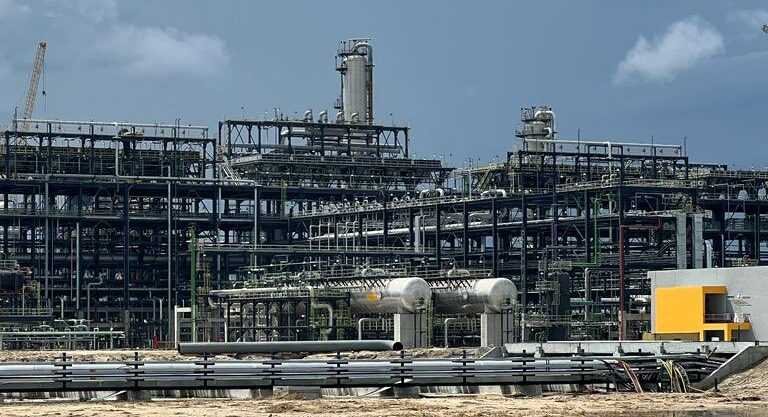
The Dangote Petroleum Refinery & Petrochemicals has reduced the ex-gantry price of Premium Motor Spirit (PMS), commonly known as petrol, to N1,200 per litre, reversing its earlier increase. The decision follows a sharp drop in global crude oil prices caused by easing geopolitical tensions in the Middle East.
The new price represents a N75 reduction from the previous rate of N1,275 per litre, which had been introduced in response to rising international oil prices and supply concerns. A senior official at the refinery confirmed the adjustment late Tuesday, explaining that the move aligns with current global crude benchmarks and market realities.
According to the official, the refinery’s pricing model responds directly to international market trends. He noted that recent tensions in the Middle East had initially pushed crude prices upward, prompting a temporary increase in refined product prices. However, the situation changed rapidly after diplomatic developments reduced fears of supply disruptions.
By Wednesday morning, the refinery reversed its earlier price hike. The official attributed the decision to a significant decline in global crude prices following an announcement by U.S. President Donald Trump of a conditional two-week ceasefire with Iran. The agreement eased concerns over potential conflict and restored confidence in stable oil supply routes.
Following the announcement, Brent crude fell by 13.28% to $94.76 per barrel, while U.S. West Texas Intermediate (WTI) dropped by 14.72% to $96.31 per barrel. The decline reflected market optimism after the United States suspended planned military action against Iran, conditional on the restoration of safe passage through the Strait of Hormuz, a critical global oil transit route.
In a telephone interview, the refinery official confirmed the reversal: “Yes, the price has been adjusted downward. This follows the current trend in crude oil prices.”
A formal statement from the refinery later clarified that there had been no further increase in petrol prices, contrary to speculation. Instead, the company confirmed a downward revision, maintaining the gantry price at N1,200 per litre and the coastal price at N1,153 per litre. The statement emphasized that the refinery’s pricing structure remains stable and that customers would continue to receive products at the adjusted rates.
The company reaffirmed its commitment to ensuring steady fuel supply across domestic and regional markets. It also stressed that its pricing decisions are guided by transparency and responsiveness to global market conditions.
This development highlights the growing influence of international oil dynamics on Nigeria’s downstream petroleum sector. The country’s fuel market has become increasingly sensitive to global price movements, foreign exchange fluctuations, and supply chain pressures since the deregulation of the sector.
The Dangote Refinery, which began operations in September 2024, has quickly emerged as a major force in Nigeria’s energy landscape. Its large-scale production capacity and integrated petrochemical operations have positioned it as a key player in determining local fuel prices and distribution patterns.
Industry analysts note that the refinery’s responsiveness to global crude trends reflects Nigeria’s deeper integration into international energy markets. As global oil prices fluctuate, domestic fuel costs now adjust more swiftly, mirroring global benchmarks.
The latest price cut offers temporary relief to consumers and businesses facing high fuel costs. However, experts caution that continued volatility in global oil prices could lead to further adjustments in the coming weeks.
In summary, the Dangote Refinery’s decision to reduce petrol prices underscores its adaptive pricing strategy and commitment to market stability. The move also illustrates how geopolitical developments—such as the U.S.-Iran ceasefire—can ripple through global energy markets, influencing local economies like Nigeria’s. As the refinery continues to align its operations with international standards, its pricing decisions will remain a key indicator of Nigeria’s evolving energy independence and market integration.