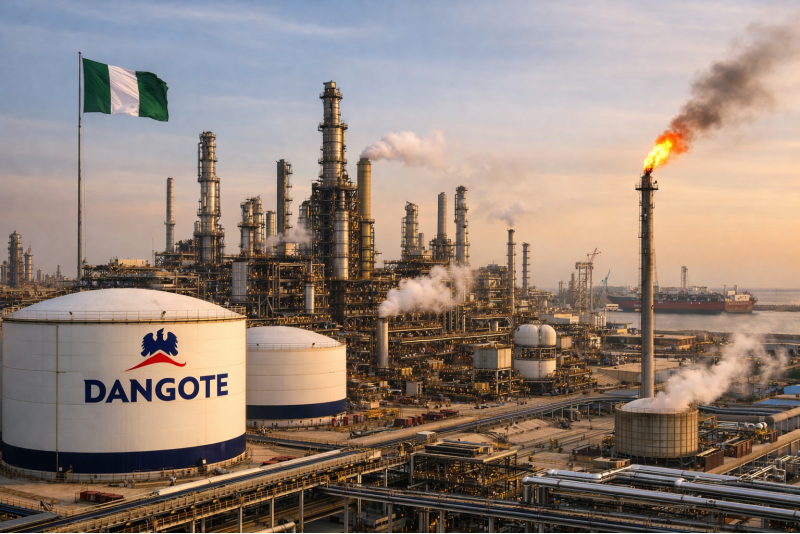
The Dangote Petroleum Refinery and Petrochemicals has begun direct deliveries of aviation fuel to Ethiopian Airlines, marking a significant expansion of its export operations at a time when global energy markets face disruption from the ongoing U.S.–Iran crisis.
Managing Director David Bird announced the development during his address at the Nigerian Association for Energy Economics (NAEE) conference in Lagos. He explained that the refinery now produces enough fuel to meet Nigeria’s domestic demand and has surplus volumes available for export to African and international markets.
Export Push Driven by Surplus Capacity
Bird emphasized that the refinery’s export drive stems from its excess production capacity. Following maintenance completed earlier this year, the plant is operating at full capacity. Since the Middle East crisis erupted on February 28, the refinery has shipped fuel to 11 African countries.
“Alhaji Aliko Dangote is absolutely unequivocal that it is Africa first,” Bird said. “We’re proud to have made a direct delivery to Ethiopian Airlines, and we will continue to export surplus volumes to Nigeria’s neighbors. We have already supplied more than 11 African countries since the war began.”
Stabilizing Jet Fuel Supply
Bird addressed concerns about jet fuel availability and rising prices, noting that the refinery’s output is helping stabilize supply in markets experiencing shortages. He stressed that the challenge is global, affecting both developed and developing nations.
“Right now, there is scarcity of product. And what is worse than $100 or $120 oil is no oil at all,” Bird said. “Countries wholly reliant on imports, whether developed like Australia or developing like Bangladesh, Sri Lanka, or the Philippines, are all facing this reality.”
He attributed the high cost of aviation fuel to surging oil prices, which reached $112 per barrel on Wednesday morning. Despite global volatility, Bird assured that Nigeria enjoys fuel abundance thanks to domestic refining capacity.
“In Nigeria, fuel remains abundant, and that is a good thing,” he said. “We cannot insulate ourselves from global price variations, but at least we have the product. We have fuel and fertilizer as a result of Dangote’s investment, and that is something we should be proud of.”
Prioritizing African Markets
Bird explained that the refinery sells products on a free-on-board (FOB) basis to a wide range of counterparties. However, he noted deliberate efforts to prioritize African markets whenever possible.
“We sell on an FOB basis to a wide variety of counterparties, but we have tried to ensure that surplus molecules are directed to African countries,” he said.
Record Margins for Jet Fuel
A Reuters report highlighted that the Dangote refinery is benefiting from record margins for producing jet fuel, much of which it sells abroad. Domestic airlines, however, have warned of possible flight suspensions due to surging fuel prices.
The refinery, the largest in Africa, was designed to transform Nigeria into a net exporter of refined products, reduce reliance on imports, and shield the economy from global energy shocks. As a new, highly efficient facility, it has capitalized on favorable margins for jet fuel production.
Crude Imports and Export Volumes
Dangote Group Vice President Devakumar Edwin disclosed that the refinery imports most of its crude from the United States, with additional supplies from African producers and Brazil. He did not provide specific figures.
Edwin said the refinery produces about 24 million liters of jet fuel daily, with the bulk shipped to Europe. Nigerian airlines, which consume an estimated 2.1 million liters per day, also receive supplies.
“As European buyers are willing to pay a premium ahead of the peak summer travel season, imports from Nigeria have averaged 78,000 to 96,000 barrels per day in April,” Reuters reported, citing data from Kpler and LSEG. This represents the highest volume on record.
Analysts estimate that while European refiners earn about $15 per barrel, Dangote’s margins are more than double due to its access to Nigerian crude and the refinery’s scale and sophistication.
Shielding Nigeria from Global Shocks
Bird reiterated that Nigeria’s domestic supply remains secure despite global turbulence. He credited Dangote’s investment for ensuring that the country has sufficient fuel and fertilizer, reducing vulnerability to external shocks.
“Thanks to Dangote’s refinery, Nigeria has fuel abundance. That is something we should be incredibly proud of,” he said.
Outlook
The refinery’s expansion into international markets underscores its role as a stabilizing force in Africa’s energy landscape. By prioritizing regional supply while capitalizing on global demand, Dangote Refinery positions itself as both a safeguard for Nigeria’s domestic needs and a competitive player in international markets.
As oil prices remain volatile and global supply chains strained, the refinery’s ability to operate at full capacity and export surplus volumes offers a rare source of stability. For African airlines like Ethiopian Airlines, direct deliveries of jet fuel provide critical relief amid escalating costs and shortages.