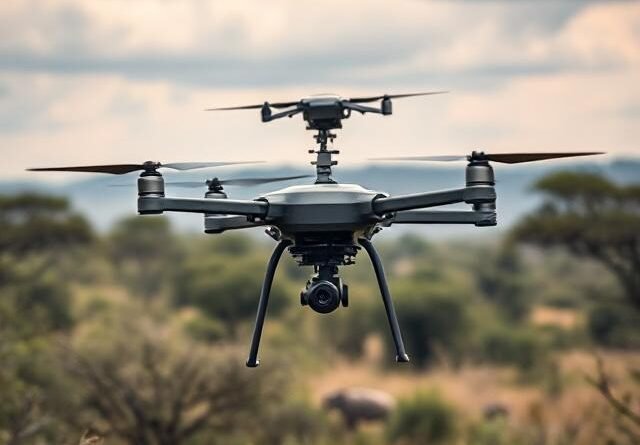
The Islamic State West Africa Province (ISWAP) has significantly expanded its drone warfare capability and is finalising plans to launch coordinated aerial attacks on Nigerian military positions in parts of Yobe and Borno states, PREMIUM TIMES can report.
A confidential security assessment sighted by PREMIUM TIMES indicates that the terrorist group intends to deploy Unmanned Aerial Vehicles (UAVs) against military formations and patrol teams operating in key conflict areas across the two North-east states.
According to the assessment, ISWAP has intensified training and experimentation with commercially available drones modified for reconnaissance and strike missions, marking a shift toward more sophisticated battlefield tactics. The planned attacks are expected to target forward operating bases, temporary camps, and troop movements, particularly in remote and contested locations.
Security sources familiar with the report told PREMIUM TIMES that the group’s drone programme has progressed beyond surveillance, with indications of payload-carrying capabilities intended to deliver explosives or conduct coordinated distraction operations ahead of ground assaults.
“The assessment points to a deliberate effort by ISWAP to replicate tactics used by its parent organisation in other theatres,” one senior security source said, requesting anonymity because they were not authorised to speak publicly. “The concern is that drones could be used to gather intelligence in real time and, potentially, to carry out precision strikes on vulnerable positions.”
The report warns that Yobe and northern Borno remain high-risk due to the terrain, limited communications infrastructure, and the frequency of patrols and resupply convoys, which could be exploited by aerial surveillance. It also notes increased procurement of drone components and the recruitment of technically skilled operatives by the group.
Nigeria’s military has not publicly commented on the specific assessment, but defence officials have previously acknowledged the growing use of drones by non-state actors in the region. In recent months, the Armed Forces have said they are strengthening counter-UAV measures, including electronic warfare capabilities, improved air surveillance, and tighter operational security around troop movements.
Analysts say the reported plans underscore the evolving nature of the insurgency in the Lake Chad Basin, where armed groups have adapted to military pressure by adopting new technologies. “The use of drones lowers the cost of reconnaissance and can negate some of the military’s advantages,” said a security analyst based in Abuja. “It also poses psychological and operational challenges for troops on the ground.”
ISWAP, a breakaway faction of Boko Haram aligned with the Islamic State group, has remained resilient despite sustained military operations. The group has increasingly focused on attacking military targets, while seeking to avoid mass-casualty attacks on civilians that could undermine local support.
PREMIUM TIMES understands that security agencies are reviewing the assessment and adjusting force protection measures in affected areas. Residents in parts of Yobe and Borno have been urged by local authorities in recent weeks to report suspicious activities, including unusual drone sightings.
As the threat landscape evolves, security experts say addressing the drone challenge will require a combination of technology, intelligence-led operations, and regional cooperation to disrupt supply chains and training networks linked to the insurgents.