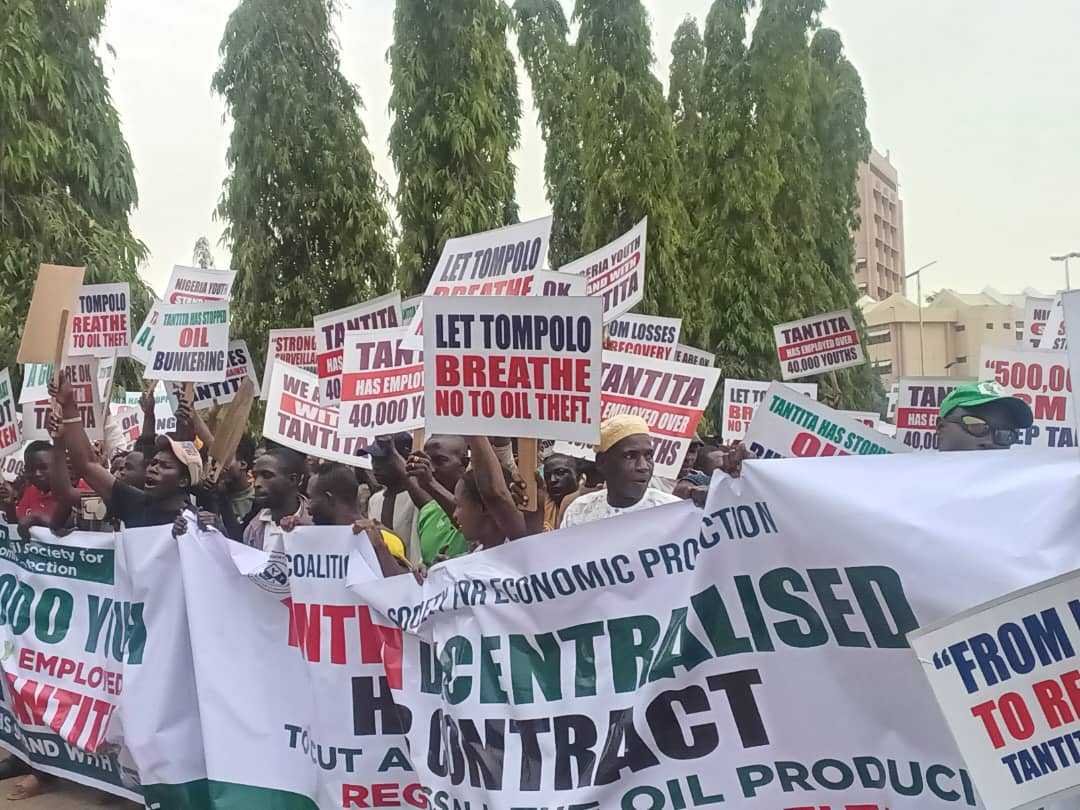
Scores of demonstrators gathered at the National Assembly in Abuja on Wednesday as lawmakers intensified discussions on crude oil theft and pipeline security in Nigeria’s Niger Delta. The protest was organized by the Coalition of Civil Society for Economic Protection, which marched to the legislative complex chanting solidarity songs and carrying placards with messages such as “Oil Thieves Are Conspiring Against Tantita” and “Say No to Oil Bunkering.”
Security personnel, including officers of the Nigeria Police Force and other agencies, prevented the protesters from entering the premises. Their demonstration coincided with heightened parliamentary focus on oil theft, a problem that has long undermined Nigeria’s crude oil output, drained government revenue, and fueled insecurity in host communities.
Later in the day, the Joint Senate and House Committees on Petroleum Resources were scheduled to hold a roundtable on pipeline security and crude oil theft. The session was expected to feature top officials, including Senate President Godswill Akpabio, House Speaker Tajudeen Abbas, Inspector-General of Police Olatunji Disu, Chief of Defence Staff General Olufemi Oluyede, National Security Adviser Nuhu Ribadu, and Minister of Defence General Christopher Musa (retd.). Other participants included the heads of the Department of State Services, National Intelligence Agency, and Tantita Security Services Limited.
Speaking to journalists during the protest, convener Tesleem Kolawole urged lawmakers to safeguard the future of the Niger Delta by strengthening pipeline security. He called for a thorough review of Tantita Security Services’ operations, stressing that results should guide decisions. “When national assets are secured, the economy benefits, communities stabilize, and young people gain opportunities,” Kolawole said. He argued that Tantita has played a visible role in restoring confidence in crude oil production.
Kolawole highlighted Nigeria’s oil production rebound, which rose to about 1.8 million barrels per day in November 2024. This marked a sharp recovery from lows of around 500,000 barrels per day before Tantita’s engagement in 2022, when vandalism and criminal activities severely disrupted output. He warned against weakening a framework that has delivered measurable gains, urging lawmakers to consolidate progress rather than disrupt it.
“Our message is simple,” he said. “This is the time to strengthen accountability, improve coordination, and protect what is working. When a programme produces measurable gains in oil security, education, skills, agriculture, and youth engagement, the responsible thing is not disruption; it is consolidation.”
Kolawole further emphasized that continuity, transparency, and support for initiatives securing national assets should remain priorities. He argued that Tantita’s record demonstrates how security and development can work together, setting a standard worth protecting for Nigeria’s future.
Crude oil theft remains one of Nigeria’s most pressing economic challenges. Successive governments have relied on military operations and private surveillance contracts to curb pipeline vandalism and illegal bunkering. The ongoing parliamentary engagement is expected to shape future policy direction, determining how best to secure oil infrastructure and sustain production gains.
The protest at the National Assembly reflects growing public concern over the issue and underscores the demand for lawmakers to act decisively. With Nigeria’s economy heavily dependent on oil revenue, the stakes remain high for both policymakers and communities in the Niger Delta.