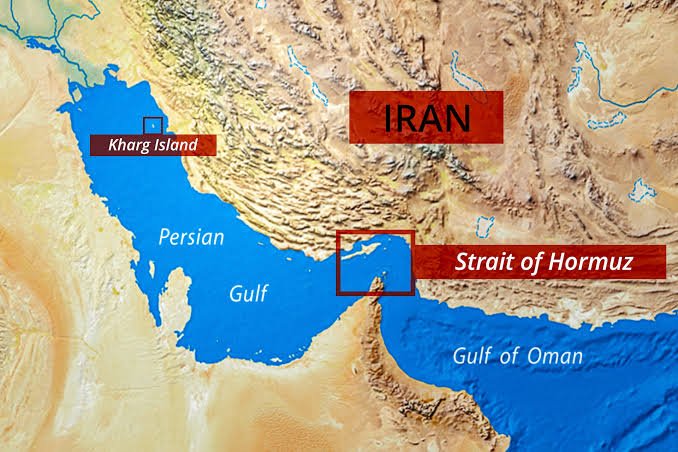
Iran’s military on Saturday announced the renewed closure of the Strait of Hormuz, only hours after it had been reopened to maritime traffic. The decision came while several commercial vessels were already navigating the strategic waterway.
The development raises fresh uncertainty over recent optimism expressed by United States President Donald Trump, who had said a peace agreement to end the US-Israeli conflict with Iran was “very close”.
Tehran had earlier reopened the strait on Friday following a ceasefire deal in Lebanon aimed at stopping hostilities between Israel and Hezbollah. The move had eased tensions in global markets and triggered a drop in oil prices. However, Iran issued a fresh warning after Washington insisted that its naval blockade on Iranian ports would remain until a final agreement is reached.
Later on Saturday, Iranian state television, quoting the country’s military central command, reported that “control of the Strait of Hormuz has returned to its previous status” and “is under strict management and control of the armed forces”, describing the action as a response to the continued US blockade.
At the same time, ship-tracking data indicated that several vessels moved quickly through the narrow passage. Many of them stayed close to Iranian waters in line with directives from Tehran. Some ships also signalled Indian or Chinese identities, a move seen as an attempt to project neutrality.
By 1030 GMT, at least eight oil and gas tankers had successfully crossed the strait. Others that had started leaving the Gulf appeared to reverse course.
Diplomatic efforts to end the conflict are ongoing, with only four days left before the expiration of a two-week ceasefire declared in the war that began on February 28.
Despite the tension, Trump maintained confidence in the talks. In a phone interview, he said “we’re very close to having a deal,” and added that there were “no sticking points at all” in discussions with Tehran. He also made remarks at an event in Arizona, where he said, “We’re going to get it by going in with Iran, with lots of excavators,” referring to Iran’s stockpile of enriched uranium.
Iran, however, dismissed the suggestion that it would surrender its nuclear materials. The country’s foreign ministry spokesman, Esmaeil Baqaei, told state television, “Iran’s enriched uranium is not going to be transferred anywhere.”
“Transfer of Iran’s enriched uranium to the US has never been raised in negotiations.”
Meanwhile, diplomatic engagement has intensified across several countries. Pakistan has taken a leading role in mediation efforts. Its military chief, Field Marshal Asim Munir, recently concluded a visit to Iran, where he met top officials. Prime Minister Shehbaz Sharif also visited Saudi Arabia, Qatar and Turkey to advance negotiations.
Egypt signalled progress in the talks. Its Foreign Minister, Badr Abdelatty, said Cairo and Islamabad were working to secure a final agreement “in the coming days”.
A new round of negotiations is expected in Islamabad next week. The talks aim to end a conflict that expanded rapidly across the region after attacks by the US and Israel on Iran. The violence drew in other actors, including Hezbollah, which launched rockets into Israel.
Although the ceasefire appears to be holding, key issues remain unresolved. These include Iran’s near-weapons-grade uranium stockpile and the future status of the Strait of Hormuz.
In a separate development, Iran reopened its airspace for international transit flights through the eastern corridor. However, internet restrictions within the country remain in place. Monitoring group Netblocks reported that the blackout, imposed at the start of the war, has now lasted 50 days.