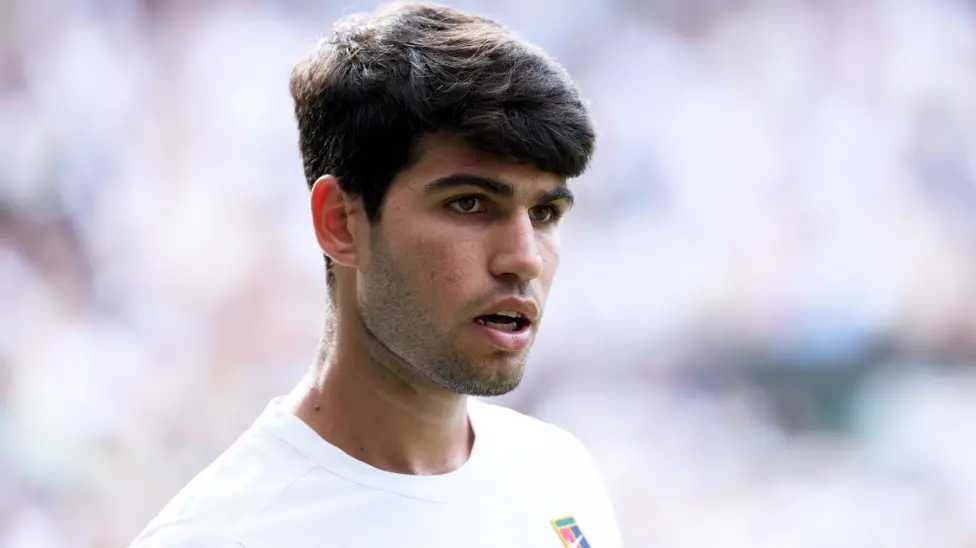
Carlos Alcaraz will not defend his Wimbledon title this year. He will not play at Queen’s either. The entire grass court season is gone — and with it, any chance of narrowing the gap that has been opening between him and Jannik Sinner at the top of men’s tennis.
The 23-year-old Spaniard confirmed Tuesday on Instagram that a wrist injury sustained in Barcelona last month has not healed in time for the grass court swing. The news was delivered with characteristic grace. It lands with significant consequences.
How the Injury Unfolded
The problem began at the Barcelona Open, where Alcaraz hurt his right wrist during a first-round match and immediately withdrew. What followed was a rapid reassessment of his entire spring schedule.
The French Open came next. Alcaraz was the two-time defending champion at Roland Garros — a title he has made his own on clay. He pulled out before the tournament began, choosing recovery over the risk of making the injury worse.
Now Wimbledon. The announcement Tuesday confirmed what many had feared once he withdrew from Paris: the wrist had not healed quickly enough, and no amount of optimism was going to change the medical reality.
“My recovery is going well and I’m feeling much better, but unfortunately I’m still not ready to compete,” Alcaraz wrote. “They are two truly special tournaments for me and I will miss them a lot. We’ll keep working to come back as soon as possible.”
A Brutal Year Takes Shape
Consider what Alcaraz has lost to a single wrist injury sustained in April.
He won the Australian Open at the start of 2026, becoming the youngest man in history to complete the career Grand Slam. The year began with history made and a seemingly limitless future ahead. Then came Barcelona. Then Paris. Now London.
The majority of the clay court season. The entirety of the grass court swing. Queen’s, where he is a two-time champion. Wimbledon, where he has won back-to-back titles and lost last year’s final to Sinner in what felt like the defining match of the sport’s new era.
All of it gone before the summer has properly begun.
The Sinner Problem
If Alcaraz’s injury is the story for him personally, its wider implications are almost entirely about Jannik Sinner.
The Italian, 24, replaced Alcaraz as world number one last month. He has now won six consecutive Masters 1,000 tournaments, including three in the past five weeks alone. He is playing tennis at a level of consistency that even his most devoted rivals have struggled to counter.
Sinner has also announced he will skip the warm-up events on grass before Wimbledon, citing a punishing run of tournaments. He arrives at SW19 rested, dominant, and with the draw now missing its most dangerous opponent.
Alcaraz at Wimbledon is a known quantity — a grass court specialist who has adapted his game to the surface with remarkable sophistication for someone his age. His absence does not simply remove a title contender from the bracket. It removes the player most likely to push Sinner to five sets and make him work for every point.
For everyone else in the draw, that is a relief. For the tournament’s appeal as a sporting contest at the very highest level, it is a loss.
The Ghost of Wrist Injuries Past
Alcaraz has been careful with his language about the injury since Barcelona, and understandably so. Wrist injuries carry a particular dread in professional tennis. They are slow to heal, prone to recurrence, and capable of unravelling careers that showed every sign of lasting a decade.
Dominic Thiem retired at the end of 2024 after a wrist injury stripped him of the power and precision that had made him a Grand Slam champion. Juan Martín del Potro won the 2009 US Open and spent much of the next decade managing a wrist that never fully cooperated again. The cautionary tales are not abstract — they are recent, they are real, and Alcaraz’s management team is acutely aware of them.
Speaking at the Laureus Awards in April, before he had even confirmed his withdrawal from Roland Garros, Alcaraz addressed it directly. “I have a very long career ahead of me, with many years still to come,” he said. “Forcing things at Roland Garros could really harm me for future tournaments.”
It was the language of a player making a long-term calculation rather than a short-term gamble. He chose correctly. The question now is how long the recovery takes and whether the wrist, once cleared, holds firm through the back half of a season that still includes the US Open.
Alcaraz’s immediate focus is straightforward: recover fully, return to the court, and rebuild momentum before the hard court season in North America. The US Open in late August remains a realistic target, and a healthy Alcaraz on hard courts is a different proposition to almost anyone else in the game.
But the rankings will not wait. Every week he is absent, Sinner consolidates. The world number one lead that Alcaraz lost last month will not shrink again until he is playing and winning — and that will not happen on any surface until the wrist allows it.
For now, Wimbledon will take place without its most recent champion. The grass court swing will proceed without its most compelling storyline. And Sinner, rested and dominant, will arrive at the All England Club as the undisputed favourite for a title that, twelve months ago, felt like it belonged to someone else entirely.