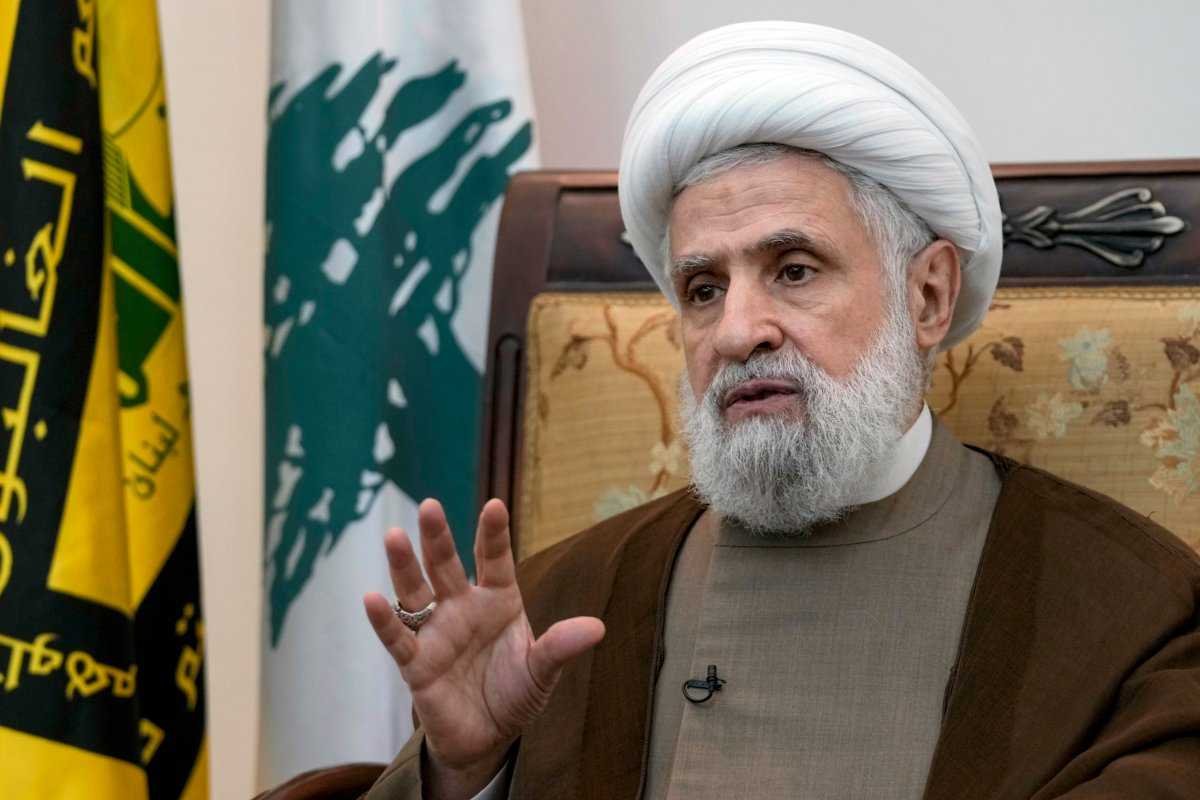
Hezbollah’s secretary-general Naim Qassem has issued his sharpest public warning yet to Lebanese authorities, demanding they abandon direct negotiations with Israel and accusing Beirut of betraying the resistance movement if talks continue.
Speaking ahead of a fourth round of Lebanon-Israel discussions scheduled in Washington early next month, Qassem left no room for diplomatic ambiguity.
“Direct negotiations are completely unacceptable and are a pure gain for Israel,” he said. “Abandon the direct negotiations and do not give to America so that it gives to Israel. Don’t be with them and stab us in the back.”
The statement signals a deepening fault line between Hezbollah and the Lebanese government at a moment when the broader regional security picture is deteriorating rapidly.
Qassem’s Disarmament Warning
Beyond the negotiations, Qassem addressed the growing international pressure on Hezbollah to disarm — a demand he rejected with force.
He warned that disarmament would lead to the movement’s “annihilation,” framing the retention of weapons not as a political choice but as an existential necessity. The remarks reflect Hezbollah’s consistent position that its armed wing exists as a deterrent against Israeli military action and cannot be separated from its political identity.
The timing is significant. Lebanon’s government has been engaged in unprecedented direct talks with Israel under American facilitation — a process that would have been unthinkable just years ago. Those discussions touch on border demarcation, the implementation of UN Resolution 1701, and the deployment of the Lebanese Armed Forces in the south.
For Hezbollah, every step Lebanon takes toward normalising contact with Israel is a strategic concession. Qassem is making clear — publicly and loudly — that the movement’s tolerance for that process has limits.
IDF Shoots Down Aerial Targets in North as Tensions Spike
Qassem’s warning did not arrive in isolation. The Israeli Defence Forces reported Thursday that “suspicious aerial targets” had triggered air raid sirens in northern Israel. The IDF stated the targets had either been intercepted or left the monitored area. No casualties were reported, but the incident underscores how fragile the current security situation along the Lebanon-Israel border remains.
The north of Israel has been on heightened alert since the broader regional conflict escalated. Drone and aerial incursion incidents have become a recurring feature of the low-intensity confrontation that has persisted even as diplomatic channels remain nominally open.
IDF Approves Plans for Continued Hezbollah Operations and Iran Resumption
The most operationally significant development came from within the Israeli military itself. IDF Chief of Staff Eyal Zamir approved plans on Thursday for continued fighting against Hezbollah — a formal military planning step that signals Israel has no intention of treating the current period as a genuine ceasefire where Hezbollah is concerned.
More strikingly, the IDF confirmed that Zamir had also approved preparations to resume the conflict against Iran. The statement that Israel is “prepared to resume the Iran conflict” represents a direct military signal at a moment when diplomatic back-channels between Washington and Tehran are still technically active.
Taken together, the IDF’s announcements paint a picture of a military that is planning for escalation on two fronts simultaneously — against Hezbollah in Lebanon and against Iran — even while politicians on multiple sides claim to be pursuing negotiated outcomes.
The Wider Stakes for Lebanon
Lebanon sits at the intersection of every pressure point in the current regional crisis. Its government is caught between American demands for direct engagement with Israel, Hezbollah’s categorical opposition to those talks, and an economy so fragile that another round of open conflict could prove catastrophic.
The Lebanese Armed Forces have been deployed to the south in larger numbers following previous agreements, but Hezbollah’s parallel military infrastructure remains intact. The gap between what Resolution 1701 demands and what exists on the ground has never been fully closed.
Qassem’s remarks Thursday are a direct message to Beirut: do not mistake American pressure for a path toward security. In Hezbollah’s reading, negotiations without the resistance movement’s consent are not diplomacy — they are surrender by another name.
Whether Lebanon’s government can sustain its engagement with Washington and Tel Aviv while managing Hezbollah’s escalating opposition is the central political question the country now faces. The fourth round of Washington talks is still weeks away. The pressure on Beirut to walk away from them is already intense.