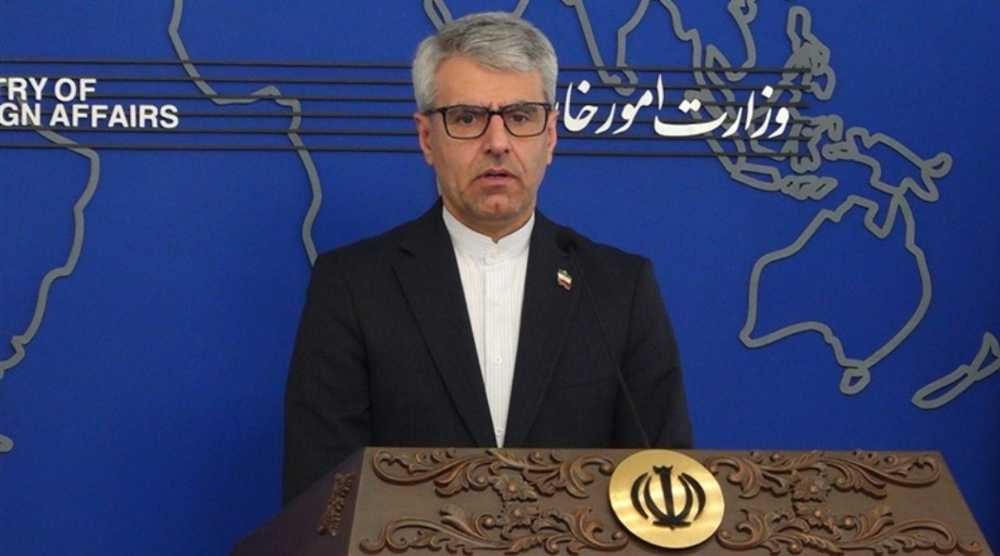
Iran has defended its recent offer to end hostilities and the crisis in the Middle East, claiming that its demands were just and based on international law. It also said that the U.S. is not ready to have any real negotiations and that the policy of the Israeli regime greatly influences its policy. https://www.presstv.ir/
Iranian Foreign Ministry Spokesman Esmail Baghaei said during his weekly press conference on Monday that Iran’s response to recent American offers was “reasonable” in terms of creating security and peace in the region. He denied that the proposal was unacceptable and said that the Islamic Republic of Iran has asked for no unrealistic concessions and its demands are based on defending its legitimate rights. “Demands by the Islamic Republic were about putting an end to military clashes in the region, stopping attacks and seizure of the Iranian shipping vessels, and releasing Iran’s financial assets frozen abroad for many years. “Why is such a demand considered unacceptable by the United States?” the Foreign Ministry spokesman asked. “Iran’s proposals are aimed at providing security for both Iran and neighboring countries as well as for the international shipping lines; securing the safe navigation through the Strait of Hormuz, one of the world’s major oil transit channels, being one of the security issues for the security of the Persian Gulf and West Asia, has been presented by the Islamic Republic of Iran as an approach that is “generous” and designed to benefit all the countries in the region and the entire world.
“Unfortunately, however, the U.S. side has addressed the issue of security not from a genuine position of wanting to establish security but in the vein and mind-set of the Israeli regime, and it should be fully aware that the negotiations will eventually encompass every issue of the proposal presented by the Islamic Republic and that it will not succeed in limiting the negotiations to only certain aspects because it is the response from the Islamic Republic of Iran to the demands from the American side,” Baghaei continued. He added that it has been weeks since the Islamic Republic of Iran has been waiting for the U.S. response to the Islamic Republic’s offers. “The problem is that Washington believes that its unilateral and coercive foreign policy is a fait accompli and intends to make the world comply with its dictated policies, and the Islamic Republic has no intention to give in to such policies,” he stated.
These remarks come amid warnings by U.S. President Donald Trump to Iran that his administration’s response to Tehran’s official counterproposal to American offers for dialogue was “completely unacceptable.”
Trump revealed on Twitter that he had “spoken with Prime Minister Netanyahu about Iran’s response to all my very friendly suggestions” and that it was “unacceptable!” Iran officially delivered its response to the U.S. proposal to the Swiss embassy in Tehran, which represents U.S. interests in Iran, on Sunday. The talks are solely about ending the present war and conflict in the region, officials reiterated. The issue does not cover broader strategic concerns, they added. During the press conference, Baghaei also responded to several long-standing accusations leveled by the United States against Iran’s regional presence, maintaining that Iran has exercised responsible regional policies despite pressure to intimidate it and has not been involved in the types of military adventurism conducted by Washington in various parts of the world. The U.S. military presence in the region was one of the main factors that caused cycles of violence and crises, he claimed.
“Does Iran deploy military forces in the world and conduct military operations in other continents as the U.S. has done? Have there been assassinations during the diplomatic negotiations, as in the case of the one during the negotiations between Iran and P5+1?” he said, suggesting that the continued U.S. military presence in the region had inflamed tensions rather than resolving them. He added that the Islamic Republic believes that all nations and states must be responsible for stability in the region. The spokesperson also elaborated on Iran’s relations with China, saying that “Beijing is a strategic partner of Tehran and fully briefed on the positions of the Islamic Republic,” while he downplayed the U.S. president’s recent visit to China, saying it was “a bilateral matter.” He said that the Iranian foreign minister has recently traveled to Beijing and that all Chinese officials have been informed of Tehran’s assessment of regional issues.
“The Chinese government understands that current tensions in the region are not only related to certain issues, but the entire pattern of American unilateralism is growing, so stability is important for both Iran and China due to economic and political considerations of this region,” he said. He added that China should prevent its strategic partners from destabilizing the region, and its economic ties should be compatible with security in the Persian Gulf and the Middle East. Baghaei was critical of reports of some European countries intending to strengthen their naval presence in the region and warned them against adopting policies promoted by Washington and Israel, telling them, “The Islamic Republic of Iran made it clear to the European governments that their participation in this venture will turn them into part of the conflict that will not benefit them in any way and that it is not appropriate for European governments to take sides with one camp that creates problems instead of focusing on ending the crisis,” he stated.
European states are being pushed to engage in actions that are in line with American and Israeli policies. The European states should know that such actions will not end the crisis but will only escalate it.” The diplomat did not neglect to emphasize that responsibility for any disturbances in maritime security rests elsewhere and international pressure should be applied where it belongs, not on Iran. The Strait of Hormuz remains the central issue, as it is one of the world’s busiest oil transit points. Iran insists that securing this waterway can only be achieved through de-escalation, not military might. Baghaei added that in its recent criticism of Iran, some Western states had deliberately overlooked the root causes of regional unrest, but real defenders of international peace should concentrate their efforts on policies that threaten maritime security and regional stability.
In another development at the press conference, Iran’s spokesman criticized the revocation of citizenship of Bahraini nationals who allegedly sympathized with the Islamic Republic. Baghaei called the move a “gross human rights violation” and condemned the practice of stripping nationality as a form of punishment, which he said was outdated, inadmissible, and inconsistent with international norms on human rights and human dignity. “The Islamic Republic of Iran has always championed human dignity, and we believe that such actions contradict this principle. The international community must show its awareness of the situation regarding human rights in Bahrain.”