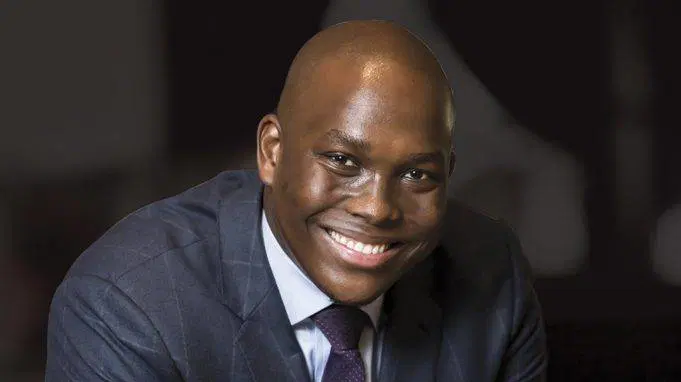
South African entrepreneur and investor Vusi Thembekwayo has dismissed claims that South Africans are inherently xenophobic, urging African nations to focus on unity and economic collaboration rather than divisive stereotypes.
Thembekwayo delivered his remarks on Friday, May 1, 2026, at The Platform Nigeria, an annual Workers’ Day event hosted by Poju Oyemade of The Covenant Nation in Lagos. The gathering, themed “Unlocking the Second Half Advantage: Transition, Impact and Legacy,” brought together thought leaders, entrepreneurs, and professionals to reflect on Africa’s economic trajectory and the role of innovation in shaping its future
Addressing the sensitive issue of xenophobia, Thembekwayo cautioned against generalizations that portray South Africans as hostile toward foreigners. He acknowledged that incidents of xenophobia exist but argued that branding an entire nation with such a label oversimplifies a complex reality.
“Contrary to what you see in the media, South Africans are not xenophobic. I am not saying there are no xenophobic individuals, but to brand the entire nation as xenophobic misses the point,” he said.
Thembekwayo emphasized that South Africa’s diversity demonstrates its capacity for coexistence. With a population of more than 60 million and 11 official languages, he described the country as one of the most diverse societies globally, where different groups largely interact and function together.
He reinforced his argument by pointing to South Africa’s corporate landscape. Many of the country’s largest companies, he noted, are led by executives from across the African continent. This, he said, reflects a level of integration that contradicts claims of systemic exclusion.
“If you look at the largest companies in South Africa, many CEOs are from other African countries. That reflects integration, not exclusion,” he added.
Beyond defending South Africa’s image, Thembekwayo shifted focus to what he described as a more pressing concern: the risk of Africans being divided by misinformation and amplified tensions. He warned that reacting emotionally to isolated incidents only deepens divides and fuels mistrust among nations.
“There is an agenda to turn us against each other. Reacting emotionally to isolated incidents only deepens divides,” he cautioned.
Instead, he advocated for deliberate dialogue and cross-border engagement. He encouraged Africans to “reach across the divide” and foster genuine understanding, stressing that collaboration is essential for the continent’s progress.
Thembekwayo highlighted the economic strength of Africa’s four largest economies — South Africa, Kenya, Nigeria, and Ghana — which collectively account for a nominal GDP of about $1 trillion. He argued that this figure underscores the power of unity over fragmentation, noting that strategic partnerships among these nations could drive sustainable development and position Africa as a global economic force.
His remarks aligned with the event’s theme of transition and legacy, urging Africans to move beyond stereotypes and embrace practical solutions for growth. He framed intra-African collaboration as a necessary step toward sustainable development, insisting that the continent’s future lies not in reinforcing national divisions but in building partnerships that leverage shared strengths.
“Our future does not lie in reinforcing stereotypes but in building partnerships that leverage shared strengths,” he said.
Thembekwayo’s speech at The Platform Nigeria sought to reframe the conversation around xenophobia, shifting focus from divisive narratives to the opportunities presented by unity and innovation. By rejecting the blanket characterization of South Africans as xenophobic, he positioned collaboration as the path to shared prosperity. His message resonated with the event’s broader goal of inspiring a new generation of innovators and nation-builders, underscoring that Africa’s progress depends on dialogue, integration, and collective action.