

Even before he became Nigeria’s president in May 2015, General Muhammadu Buhari (rtd) had already carved a distinct niche for himself in the country’s political landscape. As a former military head of state turned democratic contender, Buhari commanded a level of mass political loyalty rarely seen in Nigeria, particularly from the northern region.
From 2003 to 2015, through four successive presidential contests—three lost, one won—Buhari’s electoral base remained consistent, loyal, and vast, averaging over 12 million votes, even in defeat. To many of his supporters, he was not just a candidate; he was a symbol of integrity, simplicity, and the northern conservative political identity.
The “powerful goguwar Buhari” phenomenon
The Buhari phenomenon was not merely about party affiliation or political alliances. It was about a persona—a perception of incorruptibility, discipline, and empathy for the poor. His cult-like following, especially in the rural North, was built on trust and nostalgia. Despite criticisms of his administration’s economic performance and handling of insecurity, his personal image remained largely untarnished among his core base.
But now, more than two years after he left office, a vacuum exists, The question lingers: Who, if anyone, can step into Buhari’s shoes in northern Nigeria’s political arena?
The Contenders: Who’s Trying to Inherit the Mantle?
Several political figures have emerged, trying to court Buhari’s massive base or carve out a new one in their own image. But none has fully inherited his mystique.
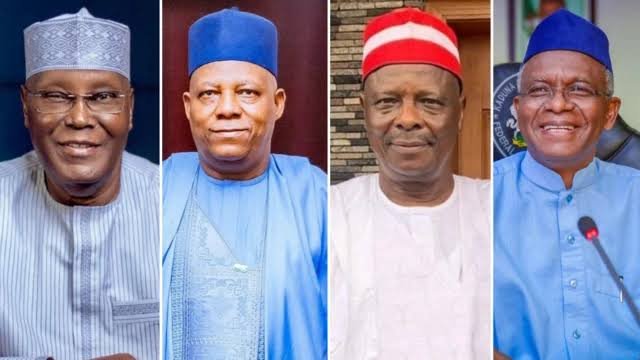
Nasir El-Rufai
The former Kaduna State governor is intellectually sharp and nationally visible. He speaks boldly and is unafraid of controversy. But his divisive politics and elite posture have alienated parts of Buhari’s grassroots base. He may appeal to technocrats and reformists, but the average voter in Kano or Katsina sees him as distant.
Rabiu Musa Kwankwaso
Charismatic and popular in Kano and among the youth, Kwankwaso’s Kwankwasiyya movement shows signs of populist strength. But his influence is largely regional, and his fallout with Buhari during their time in APC politics may limit his chances of claiming Buhari’s loyalists.
Abdullahi Umar Ganduje
As a long-time political ally of Buhari and the current National Chairman of the APC (until recently), Ganduje held a strategic position. But allegations of corruption and his lukewarm national image make him an unlikely heir to Buhari’s moral image.
Atiku Abubakar
Though a northerner with deep political roots, Atiku represents a different elite class of politician—more liberal, more business-oriented and less trusted by Buhari’s conservative base. He remains a formidable player, but not a direct successor in terms of ideology or style.
Kashim Shetima
Nigerian vice president is a another strong contender, most especially looking at the strategic position he is holding.
He is currently the most senior political office holder in the region .
He was a former governor of Borno state, where he governed at the peak of Boko Haram war.
It was because of Boko Haram war that he enjoys a very positive goodwill from his people.
Babagana Zulum
Tye current Borno state governor is a very popular politician in Northern Nigeria.
He’s seen by many as a governor with sympathy and empathy, especially when handling the affairs of his people that have been somehow degraded by Boko Haram menace for over a decade.
The Vacuum That Remains
No politician today commands the blind loyalty Buhari once did in the North. His influence went beyond policy or rhetoric—it was emotional, symbolic, even spiritual for many of his followers. His image was painted on walls, recited in slogans, and worn on T-shirts. That kind of raw connection cannot be manufactured overnight.
The Rise of a New Northern Mahadi?
Observers believe the next northern mass leader may not come from among the old guard With the rise of social media, a younger, more articulate, and digital-savvy generation may redefine what northern leadership means.
A political analysis, Dr Kabiru Sufi, who spoke with BBC said only Kwankwaso and his Kwankwasiyya ideology has a clear chance of taking over from Buhari.
But he said there are other good politicians, “but they need patience and more steadfastness to be like Buhari,” he said.
But despite having some good politicians in the region, the question remains: Can anyone build the kind of trust, simplicity, and symbolism that Buhari embodied?
Buhari’s political shoes are large—maybe too large for any one person to fill. As northern Nigeria navigates a post-Buhari identity crisis, the political space remains open, fragmented, and dynamic.
Who will step in—not just with ambition, but with the authenticity to unite millions?
The answer, it seems, is still in the making.




Comments 1