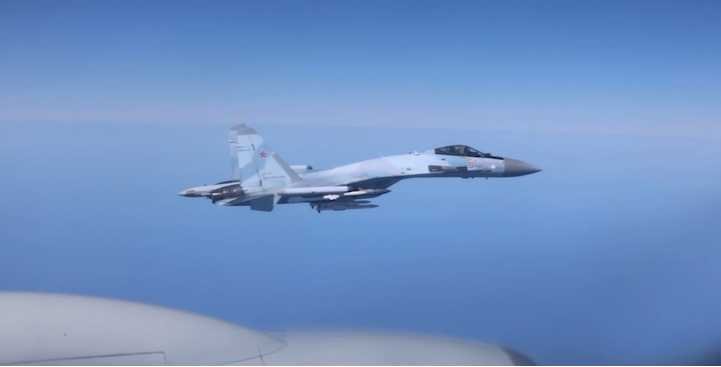
Two Russian fighter jets intercepted a British surveillance aircraft over the Black Sea in what the UK Ministry of Defence (MoD) described as a dangerous encounter. The incident, which occurred last month, involved close maneuvers that forced the RAF plane’s emergency systems to activate.
The MoD reported that a Russian Su-35 fighter approached the RAF’s RC-135W Rivet Joint, flying so close that its autopilot disengaged. A second jet, a Su-27, made six passes in front of the aircraft, at one point coming within six metres of its nose. Officials called the actions reckless and unsafe.
Defence Secretary John Healey condemned the interceptions. He praised the RAF crew for their professionalism under pressure, calling the Russian maneuvers “unacceptable.” According to Healey, such actions risk accidents and escalation. He stressed that Britain’s commitment to NATO and its allies remains firm despite these provocations.
The Rivet Joint was on a routine mission, gathering intelligence to support NATO’s eastern flank. The MoD emphasized that the aircraft was unarmed and operating in international airspace. The UK has since demanded an explanation from Russia through its embassy in London.
This latest confrontation is considered the most serious since 2022, when a Russian pilot fired a missile at another Rivet Joint over the Black Sea. At the time, Moscow claimed the launch was due to a technical malfunction. Western defence sources later suggested the pilot acted on a confusing command from a ground station. The missile missed, but the incident raised alarm across NATO.
The MoD linked the recent interceptions to broader Russian activity in the region. Officials pointed to submarine movements near critical British infrastructure in the North Sea as part of a pattern of aggression. The UK government warned that such behavior undermines stability and increases the risk of unintended conflict.
The RAF’s Rivet Joint aircraft, operated by No. 51 Squadron from Lincolnshire, is a key intelligence platform. It uses advanced sensors to intercept and analyze signals, providing real-time information to military commanders. Its role is vital in monitoring Russian operations and supporting NATO’s defensive posture.
Healey’s statement underscored the UK’s determination to continue these missions. He said Britain will not be deterred from defending its allies and interests. The MoD added that the professionalism of the RAF crew prevented the situation from escalating further.
The incident highlights the tense atmosphere over the Black Sea, where NATO and Russian forces often operate in proximity. With the war in Ukraine ongoing, the region remains a flashpoint for military encounters. Analysts warn that repeated close interceptions increase the risk of miscalculation.
For Britain, the episode reinforces the importance of surveillance flights in deterring threats and maintaining situational awareness. For Russia, the maneuvers signal a willingness to challenge NATO presence. The confrontation reflects the fragile balance of power in the region, where a single mistake could have far-reaching consequences.
As tensions persist, the Black Sea remains a contested space. The RAF’s experience shows how quickly routine missions can turn hazardous. It also demonstrates the professionalism required to navigate such encounters without escalation. The UK’s response signals that it views these actions not as isolated incidents, but as part of a wider pattern of Russian hostility.