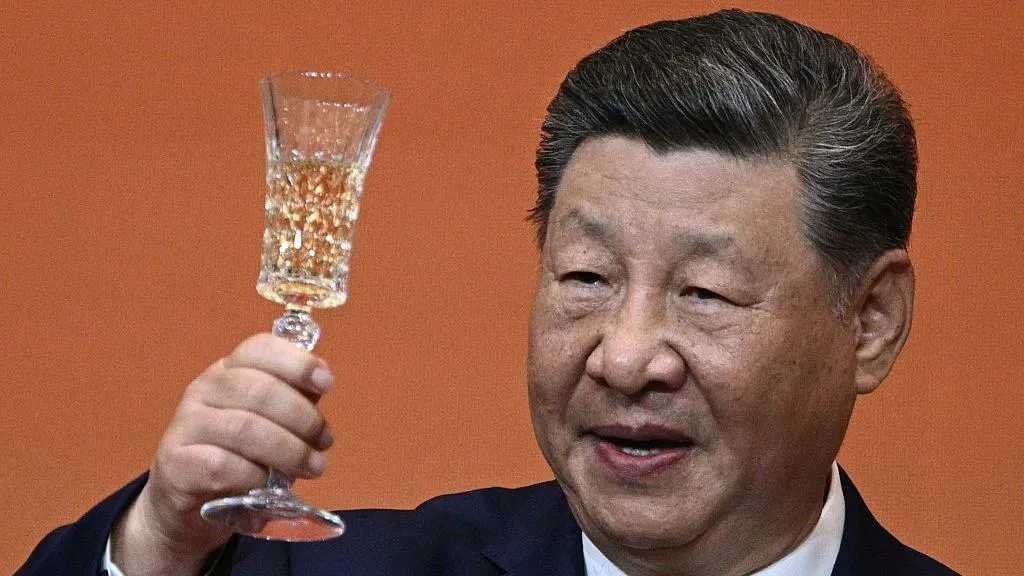
In the space of eight days, Xi Jinping hosted the leaders of the world’s two other great powers on Chinese soil, received them with identical military pageantry, and sent both home with carefully worded joint statements and the unmistakable impression that Beijing is now where the world’s most consequential conversations happen.
First came Donald Trump. Then came Vladimir Putin.
Two visits. Two cannon salutes. Two marching bands. Two heads of state welcomed outside the Great Hall of the People by cheering schoolchildren waving flags.
The choreography was almost identical. The politics driving each visit could not have been more different. And in the gap between those two realities lies both the extraordinary achievement of Xi’s diplomatic moment and the fault lines running beneath it.
China’s Calculated Rise to the Centre
For Xi, the optics of this week were not accidental. They were the point.
Hosting Trump and Putin in rapid succession sends a precise message to every government watching: Beijing talks to everyone, aligns exclusively with no one, and can convene the world’s most powerful leaders on its own terms, in its own capital, on its own timeline.
This is a message China has been building toward for years — quietly, strategically, and with the kind of patience that distinguishes long-term statecraft from short-term political calculation.
“The new era of world affairs is less centered around the West,” says Samir Puri of King’s College London. “There is a lot of latent power that China has on the world stage. China’s style is to try to utilise its stature in a more gradual sense.”
Gradual, perhaps. But the acceleration over the past five years has been striking.
In 2020, China appeared to be heading toward diplomatic isolation. Its borders were sealed. The COVID-19 pandemic — which Trump had branded the “Chinese virus” — had damaged its global reputation. Relations with the West had deteriorated sharply through a period of aggressive “wolf warrior” diplomacy, in which Chinese officials and state media used combative rhetoric to silence international critics. Sanctions, export controls, and mounting criticism over Xinjiang and Hong Kong had left Beijing embattled on multiple fronts.
Five years later, world leaders from Canada, Germany, and the United Kingdom have walked Beijing’s red carpet seeking trade deals. China has repaired ties with Australia and key American allies across the Indo-Pacific. Rather than being managed as a threat to contain, it is being engaged as a power too central to ignore.
The shift is real, deliberate, and built on foundations that Trump’s own unpredictability has, paradoxically, accelerated.
The Two Wars, the Two Leaders, and China’s Upper Hand
What gave Xi particular leverage in both summits was something that money and military force cannot manufacture: the other side needed him more than he needed them.
Trump arrived in Beijing burdened by a Middle East war that has blocked the Strait of Hormuz, rattled global energy markets, and sent his domestic approval ratings into decline. He needed Xi to use China’s relationship with Tehran to help broker a ceasefire — a difficult ask from a position of visible vulnerability.
Putin arrived carrying the weight of a Ukraine invasion now entering its fifth year. Western sanctions have pushed Russia into increasing economic dependence on China. Beijing is now Moscow’s largest trading partner and its biggest buyer of oil and gas. Putin needs Xi’s continued economic partnership to sustain a war that has isolated Russia from the rest of the developed world.
In both cases, Xi was the one sitting with options. That is an unusual position for any leader. It is a historically significant one for China.
“Both China and Russia need each other, but Russia clearly needs China more than before,” says Dr Zheng Runyu of East China Normal University. “Deep co-operation with China is extremely important for Russia in dealing with many of its current challenges.”
For the Chinese public, the symbolism was equally powerful. For over a decade, Xi has promised his people the “great rejuvenation of the Chinese nation.” This week, that promise had a face — the most powerful leaders on earth, queuing to meet him in Beijing.
Putin’s Visit: Warmth, Agreements, and a Pipeline Still on Hold
Putin and Xi share a personal rapport built over years of carefully managed summitry. Putin has visited China more than 20 times. The two leaders have developed what both governments describe as a relationship of strategic trust.
But the dynamics of that relationship are shifting — and Tuesday’s summit reinforced the imbalance.
The meetings produced more than 20 agreements on trade and technology. A lengthy joint statement was issued. Both leaders expressed solidarity on a range of international issues. Yet the deal Putin has been pushing for years — approval for a major Russian gas pipeline through China — remained unsigned. Beijing chose not to give Moscow that particular prize.
The message was subtle but unmistakable: China values the relationship, but it will not be rushed or pressured into commitments that do not serve its own interests. Russia is a partner. It is not an equal.
The Ukraine Silence That Europe Cannot Ignore
Here is where Xi’s extraordinary week develops its most significant problem.
In his public remarks and joint statement with Putin, Xi mentioned one ongoing conflict: the war in Iran. He called a complete end to it a matter of “utmost urgency.”
Ukraine, where hundreds of thousands have died and where Russia’s invasion has now ground through a fifth year, went unmentioned.
Instead, Xi and Putin issued a joint denunciation of what they described as “treacherous military strikes against other countries, the hypocritical use of negotiations as cover for preparing such strikes, the assassination of leaders of sovereign states” and “the provocation of regime change.” The language was unmistakably aimed at the United States and its regional operations.
European governments noted all of this carefully. They are still being courted by Beijing, which is seeking stronger trade ties with the EU to offset the impact of American tariffs and bolster an export-dependent economy. But calling for peace in the Middle East while remaining silent on an invasion that Europe considers the defining security threat of the current era raises a direct question about whether China can be trusted as a genuinely neutral global actor.
“Obviously, Xi Jinping could take the easier way out and say nothing about it,” Puri observes. “Of course, tacitly this means — Russia, carry on with your invasion.”
Beijing’s position on Ukraine has always been deliberately ambiguous. It has nominally maintained neutrality while continuing to provide the economic lifeline that enables Moscow to sustain the war. That ambiguity served China when the conflict was primarily a European problem. As China seeks a larger role on the global stage, the same ambiguity is becoming a credibility liability.
The Limits of China’s New Power
From Abuja to Accra, from Lagos to Nairobi, Africa watches China’s rise with a mixture of admiration, pragmatism, and — increasingly — questions.
China is Africa’s largest bilateral creditor. It is a major investor in infrastructure across the continent. Dozens of African nations have signed Belt and Road agreements. For many African governments, Beijing’s economic engagement has provided an alternative to Western-conditioned lending and an additional space for diplomatic manoeuvre.
But Africa also knows the cost of diplomatic silence. The continent lived through decades of Cold War power games in which great powers pursued their interests while African suffering went strategically unacknowledged. China’s silence on Ukraine — while simultaneously demanding Western restraint in the Middle East — echoes a familiar hypocrisy that selective international outrage always produces.
Xi’s China wants the prestige of global leadership without accepting all of its obligations. That is a calculation that works in the short term. Over time, it erodes the credibility that global influence requires.
The Bigger Picture: An Indispensable Power With Unresolved Questions
Step back from the summit theatre — the cannon fire, the marching bands, the schoolchildren waving flags — and the structural reality of China’s position is both genuinely impressive and genuinely complicated.
China now manufactures a third of the world’s goods. It processes more than 90 per cent of global rare earth minerals. It dominates the production of solar panels, wind turbines, and electric vehicles. Its economy, despite a domestic slowdown driven by real estate crisis and rising local government debt, remains the world’s second largest and central to almost every major global supply chain.
That is real power. It is not rhetorical.
But power of that scale comes with accountability that Xi is still selectively applying. A China that calls for an end to war in the Middle East while enabling a war in Europe is not a neutral power broker. It is a strategic actor managing competing relationships — which is legitimate, but should be described honestly.
The world’s roads may increasingly lead to Beijing. But where Beijing chooses to lead the world — and which conflicts it chooses to address or ignore along the way — will ultimately determine whether Xi’s extraordinary diplomatic moment becomes a genuine turning point in global history, or simply the most impressive performance of enlightened self-interest that the 21st century has yet produced.
For now, the spotlight shines on Xi. He is holding it with considerable skill.
The harder questions are only beginning.