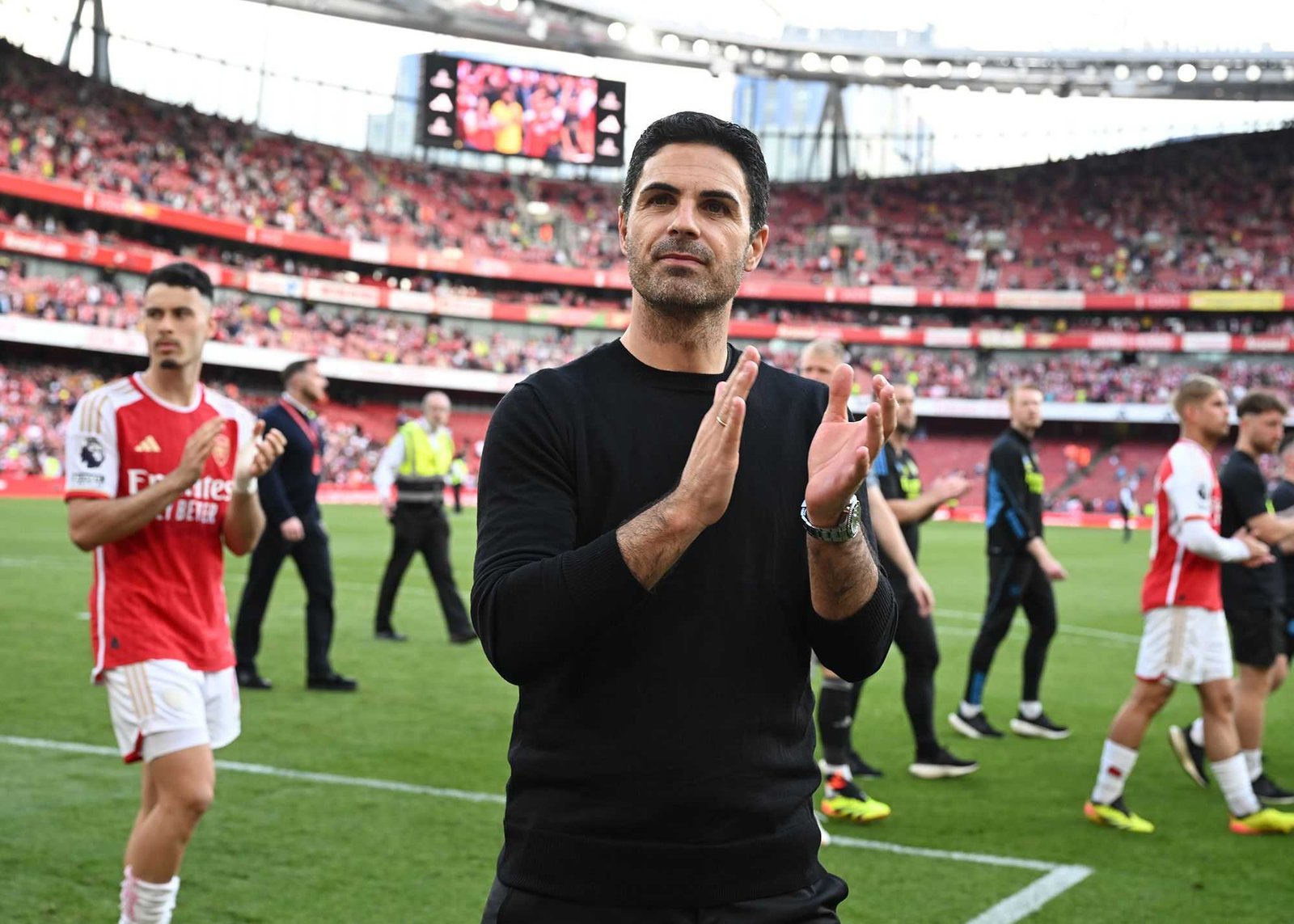
When Arsenal were confirmed as Premier League champions, the celebrations at London Colney were everything you would expect. Players danced. Staff embraced. Declan Rice, Bukayo Saka, and Jurrien Timber partied deep into the night. Thousands of supporters flooded the streets around the Emirates. Club legend Ian Wright was in the thick of the crowd, living every moment.
Mikel Arteta was at home. On his sofa. With his family.
Not because he did not care. Not because the moment did not move him. But because that is exactly who Mikel Arteta is — and understanding that choice unlocks something essential about the man who just ended Arsenal’s 22-year wait for a league title.
A Night That Changed Everything
The moment arrived on a Wednesday evening when Manchester City drew 1-1 with Bournemouth at the Vitality Stadium. That single dropped point sealed it. Arsenal were champions — not by winning themselves, but by watching the team that had frustrated their ambitions for two consecutive seasons finally fall short.
The squad had gathered at London Colney to watch the City game together. When the final whistle blew, the training ground erupted. The scenes were raw, emotional, and unscripted — the release of years of near-misses, close calls, and the grinding frustration of finishing second while believing they were good enough to win.
Across north London, the reaction mirrored it. Supporters who had lived through 22 barren years — who had been told the Invincibles season of 2003-04 might never be matched — allowed themselves, finally, to celebrate.
Arteta watched it all from his living room.
A Deliberate Choice, Not an Oversight
This was not a scheduling conflict or a logistical miss. Arteta had announced his intention days earlier, with the quiet certainty of someone who had already decided where he needed to be for a moment this significant.
“I will be there in front of the TV,” he said before the City match. “But I don’t know how much I’m going to be able to watch — I think that’s the reality.”
Asked whether he would join his players if the title was confirmed, he was equally direct. “I haven’t planned to do that. I’m planning to watch it with my family.”
Something is revealing in that answer. Arteta did not hedge or leave the door open. He had thought about it, made a decision, and committed to it — just as he has approached every other aspect of Arsenal’s rebuild.
For a coach who has been the most visible and intense presence at Arsenal since his arrival in December 2019, the choice to step back from the celebrations speaks volumes. The title was never about him. It was always about the club, the players, and the supporters who had waited so long for it.
The Records Behind the Name
When the history books settle on this Arsenal title, Arteta’s personal achievements within it will demand their own chapter.
At 44 years and 54 days old, he became the youngest Arsenal manager to win the league championship — narrowly ahead of the legendary George Graham, who was 124 days older when he led the club to the title in the famous 1988-89 season. Only José Mourinho, who won the Premier League with Chelsea at 42 years and 94 days in 2004-05, has claimed the trophy at a younger age.
He also became the first former Arsenal player to manage the club to a top-flight title. He came to Highbury as a midfielder under Arsène Wenger, won FA Cups, and absorbed a football education that he has now deployed to historic effect. The full circle of that story is not lost on the supporters who watched him play and have now watched him deliver what Wenger himself could not quite manage in his final years.
Unfinished Business: Budapest Awaits
For all the celebration and all the history, Arteta’s mind has already moved on. That is another defining trait of the man — the inability to rest when there is more to be achieved.
Arsenal travel to Selhurst Park on Sunday to face Crystal Palace, where they will receive the Premier League trophy in what amounts to a travelling celebration. North London will be everywhere in south London that afternoon.
But the real focus is Budapest. On May 30, Arsenal face Paris Saint-Germain in the Champions League final — the last piece of what could be a historic domestic and European double. It is the kind of occasion the club has not experienced since the 2006 final in Paris, a night that ended in heartbreak against Barcelona.
This time, the squad is different. The manager is different. The belief is different.
What the Sofa Says
Arteta’s decision to watch Arsenal’s title confirmation at home, surrounded by his family, is a small detail in the context of what has been achieved. But small details tend to define big people.
He did not need the cameras or the crowd to validate the moment. He did not need to be seen celebrating to confirm his place in Arsenal’s history. That place is secure — built not on one evening but on years of work, decision-making, squad construction, and the relentless pursuit of a standard that was once considered beyond this club’s current reach.
The players will rightly get their moment in the sun. The supporters deserve every second of their celebration.
Arteta will get his in Budapest. And on the evidence of everything he has built at Arsenal, it would be unwise to bet against him delivering there too.