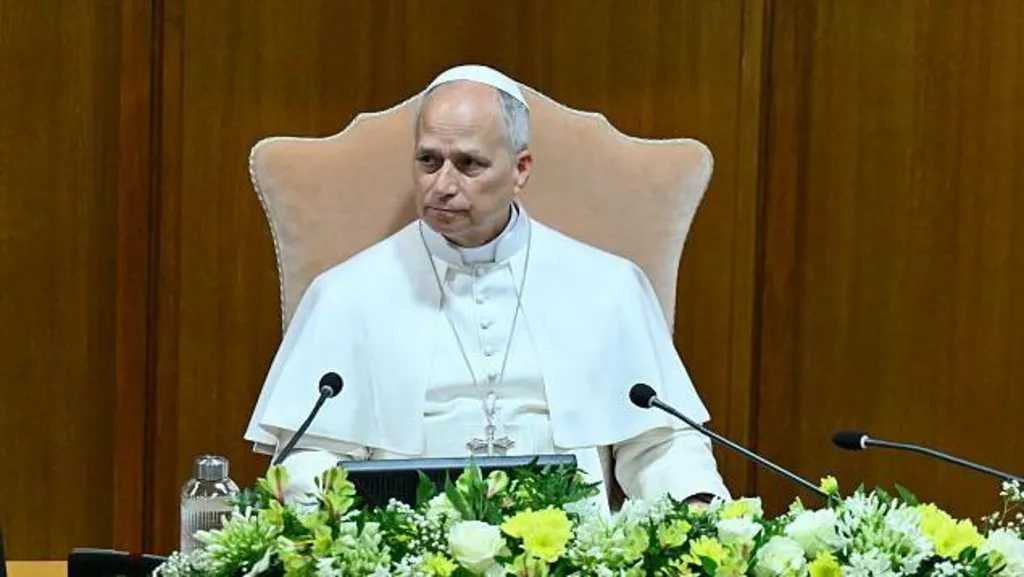
Pope Leo has fired his first major shot as leader of the world’s 1.4 billion Catholics — and he aimed it directly at artificial intelligence.
In his debut encyclical, titled Magnifica Humanitas (“Magnificent Humanity”), the Pope issued one of the most forceful and wide-ranging papal interventions on technology in the Church’s history. The document covers AI in warfare, political manipulation, economic exploitation, and the threat of what Leo calls “new digital slaveries.”
The language was deliberate. The message was urgent. And the Pope made clear he chose his words to demand attention, not comfort.
“The word is strong, I know, but deliberately chosen because this moment needs words capable of attracting attention,” Leo said of his call to “disarm” AI.
Slavery, Then and Now
The most striking dimension of the encyclical is not its warnings about technology alone. It is the moral framework Leo used to deliver them.
The Pope opened with one of the most comprehensive apologies the Vatican has ever issued for the Catholic Church’s role in the transatlantic slave trade. “It is impossible not to feel deep sorrow when contemplating the immense suffering and humiliation endured by so many,” he wrote, adding that he “sincerely asked for pardon” in the Church’s name.
He did not stop there. He drew a direct line between that historical atrocity and the emerging dangers of artificial intelligence, warning that humanity risks normalising exploitation again, this time in digital form.
The parallel is deliberately confrontational. Leo is not using slavery as a distant metaphor. He is arguing that the same moral failure that allowed societies and the Church to remain silent for too long on slavery is now repeating itself in the face of unchecked AI development.
“The delay with which both society and the Church came to denounce the scourge of slavery,” he wrote, should not be repeated with the threats of AI.
For an African audience — Nigerian readers especially — this framing carries particular weight. The transatlantic slave trade hollowed out West Africa for generations. A Pope who names that history directly, connects it to present-day digital exploitation, and places the Church’s complicity on record is saying something that matters well beyond the walls of the Vatican.
AI in War: “No Algorithm Can Make War Morally Acceptable”
The encyclical’s sharpest policy position concerns the use of artificial intelligence in military applications.
Leo condemned the integration of AI into weapons systems with unambiguous clarity. Reducing human control over warfare, he argued, makes it even harder to meet the threshold of a “just war” — a concept the Catholic Church has long used to evaluate the moral legitimacy of armed conflict.
“No algorithm can make war morally acceptable,” he wrote.
He went further. AI does not remove the “intrinsic inhumanity” of war, the Pope argued. It accelerates it — lowering the threshold for resorting to violence, transforming defence into threat prediction, and reducing victims to data points. The human cost of war becomes abstracted, and with abstraction comes a dangerous ease.
At a moment when AI-powered drone systems are being deployed in active conflicts — including in the Middle East and Ukraine — the Pope’s words land with direct relevance. They are not theoretical warnings. They are a moral verdict on decisions being made right now, by governments and arms manufacturers who will receive this encyclical and must decide what to do with it.
Digital Colonialism and the Politics of Manipulation
Leo also addressed AI’s impact on politics — specifically the manipulation of images and videos to distort reality and push populations toward “biased or misleading perspectives.”
This concern is not abstract in any democracy, including Nigeria’s. The 2027 general elections are approaching. Digital manipulation of political content, deepfakes, AI-generated misinformation — these are not future threats on the African continent. They are present ones. The Pope’s encyclical, by naming political manipulation as a specific AI danger, speaks directly to the vulnerabilities that developing democracies face.
The Pope also coined the phrase “digital colonialism” — linking the economic and cultural abuses of the colonial era to the way powerful technology companies from wealthy nations extract data, shape narratives, and consolidate control over digital infrastructure in the Global South.
For Nigerian readers, that phrase resonates. The colonial experience is not distant history. The transfer of economic dependency from physical resources to data and digital infrastructure is a pattern that African policymakers are only beginning to grapple with. Leo has given that concern a moral vocabulary.
An Unusual Presentation — With Anthropic in the Room
The manner in which this encyclical was presented was itself a statement.
Pope Leo chose to present Magnifica Humanitas personally at the Vatican — an unusual step for a papal teaching document. Alongside him stood Christopher Olah, co-founder of Anthropic, one of the most powerful AI development companies in the United States.
Olah did not shy away from the weight of the moment. “Every AI lab, including mine, operates inside a set of incentives and constraints that can sometimes conflict with doing the right thing,” he said.
He added something that carries its own significance: “The questions raised by AI are bigger than the AI research community — not just in their implications, but also in their nature.”
A leading AI developer standing beside the Pope, acknowledging that his industry’s incentives can conflict with ethical responsibility, and endorsing the idea that technologists alone should not determine AI’s future — that is not a minor moment. It is a signal that even within the industry, there are voices who recognise the need for external moral authority.
The Risk of Beautiful Words Without Action
The Pope’s encyclical will be read, discussed, quoted, and praised across the world. It will appear in academic syllabi, ethics curricula, and policy debates for years.
Whether it changes anything is a different question.
The precedent is not encouraging. In 2015, the late Pope Francis published Laudato Si — a landmark encyclical on the climate crisis that was universally acknowledged as moral and urgent. By 2023, Francis himself expressed deep disappointment at the inaction that had followed.
Leo has established a commission to carry his AI work forward. Whether that commission can move faster than the technology it is trying to govern is the question nobody has yet answered.
AI is not waiting for papal commissions, legislative frameworks, or ethical guidelines to catch up. The systems being built today will be deployed tomorrow. The moral reckoning Leo is calling for requires speed, political will, and corporate accountability that encyclicals alone cannot compel.
What This Means for Nigeria and Africa
Nigeria is not a bystander in this story. The country has a growing technology sector, a young population increasingly shaped by digital platforms, and a democratic system vulnerable to the exact forms of AI-driven manipulation the Pope has condemned.
Developers, policymakers, and civil society leaders in Nigeria should read Magnifica Humanitas not as a foreign document but as a framework that addresses conditions on this continent directly — exploitation, manipulation, colonialism in new forms, and the risk of technological development that serves the powerful at the expense of everyone else.
Pope Leo has spoken. The harder work — deciding what to do about it — now belongs to the rest of us.