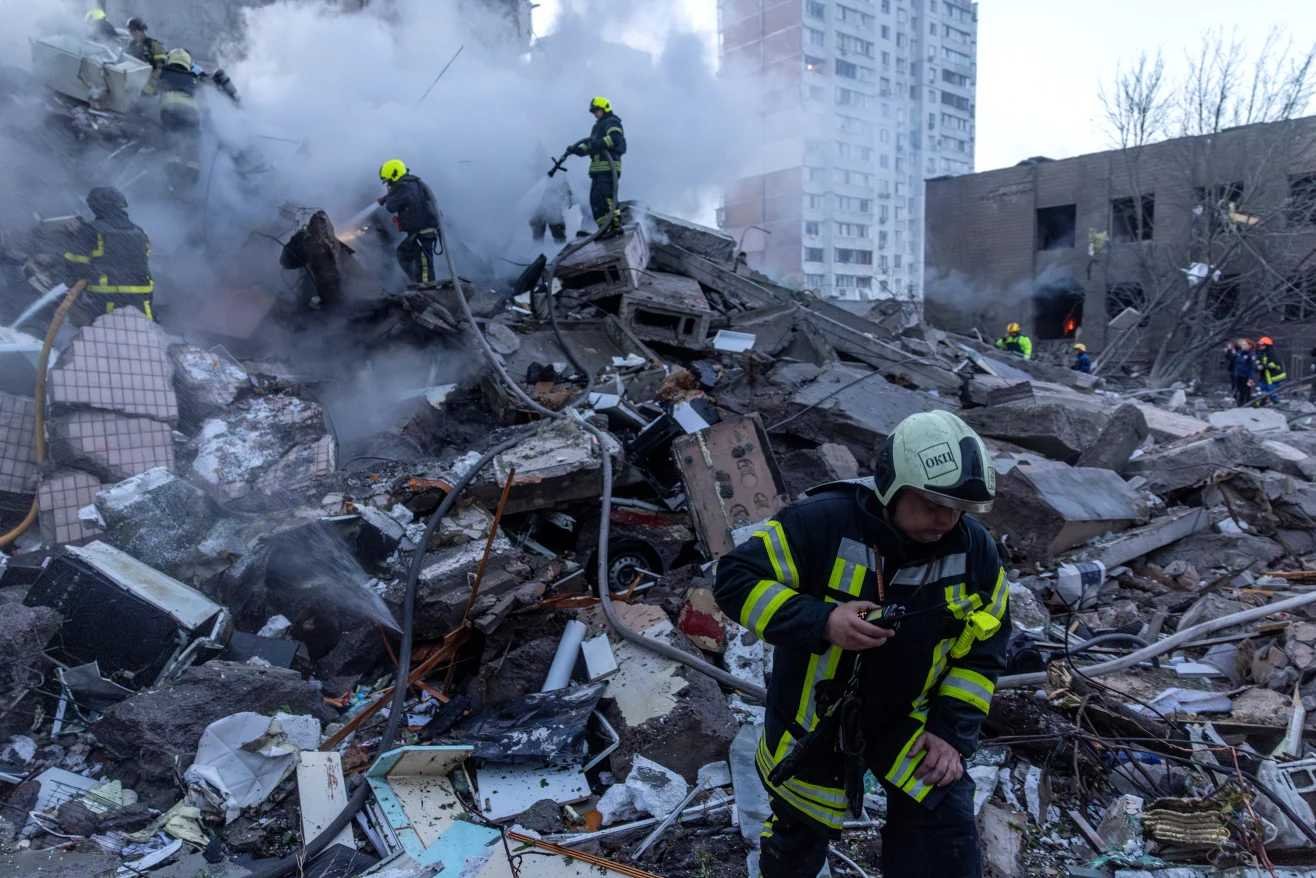
Russia launched its most devastating aerial assault of the entire war on Ukraine, firing more than 1,560 drones and 56 missiles over two days — a barrage that killed at least 12 people in Kyiv, injured dozens more across the country, and left a nine-story residential building in rubble.
Ukrainian President Volodymyr Zelensky confirmed Thursday that the scale of the attack was unprecedented. No previous two-day period since the war began in 2022 has seen this
volume of aerial fire directed at Ukraine.
Air raid sirens rang out for roughly 11 hours across Wednesday and into the early hours of Thursday, according to CNN journalists on the ground in Kyiv.
A Residential Building Destroyed, Lives Lost
The deadliest single strike hit a nine-story apartment block in Kyiv. At least 11 people died there, among them a 12-year-old girl. Kyiv Mayor Vitali Klitschko confirmed a 15-year-old girl was also among the dead. A twelfth victim — a man injured in a separate attack on a gas station — died later in hospital.
Emergency services warned the death toll could rise. More than a dozen residents were reported missing, with rescuers still searching the wreckage for survivors trapped beneath the debris.
Olena Suntovska, 38, a mother of three who lived in the building, described the moment of impact. “I heard a loud explosion. I ran out to the kitchen and saw people running around the yard, calling for help. Then I rushed out of the building and saw that the front entrance was gone.” She added: “I was scared — it’s so stressful for me because I was worried about the kids.”
Another resident, 76-year-old Polina, was jolted awake to find her balcony window blown out. “I never imagined the damage would be this bad,” she said. “When I went out into the yard, I couldn’t believe my eyes.” She pointed to a gap that has long worried residents: “We don’t have a proper bomb shelter here. There’s only one in a nearby building, not in ours, so we don’t go anywhere underground.”
Klitschko called it “the enemy’s largest-scale attack on the capital” and declared a day of mourning for Friday.
Zelensky: Russia Stockpiled Weapons to Maximise Damage
Zelensky said the timing of the assault was deliberate. Russia had stockpiled drones and missiles over a sustained period, he said, and then launched them in a coordinated wave designed to overwhelm Ukraine’s air defences and maximise destruction.
“The strike was timed to ensure its scale was significant and the challenges for our air defence were as great as possible,” Zelensky said. He confirmed Ukraine is preparing a response, though gave no further details.
The two-day assault stretched Ukraine’s defences across multiple regions simultaneously — a strategy Moscow appears to have refined to stretch air defence resources thin across a wide front.
Kharkiv, Odesa, and Beyond: The Attack Spreads Nationwide
Kyiv was not the only target. By Thursday morning, strikes on Kharkiv had injured at least 28 people. Two further injuries were reported in the Odesa region.
The assault also reached the regions of Poltava and Zaporizhzhia, where Russian drones and missiles struck energy and railway infrastructure. The damage was not merely civilian — it was strategic.
Energy company DTEK reported that a power substation and a high-voltage power line in Kyiv were knocked out following the overnight missile and drone strikes — a deliberate attempt to cut electricity to the capital. Ukraine’s national railway operator, Ukrzaliznytsia, said a train locomotive in the Kharkiv region was hit directly, though its crew evacuated in time.
Escalation at a Critical Moment
The timing of Russia’s largest aerial attack is not incidental. It comes as international diplomatic efforts — including pressure from Washington — continue to push for a ceasefire negotiation. Moscow’s response has been to escalate, not engage.
The scale of Wednesday and Thursday’s assault signals that Russia is not only maintaining its military campaign but intensifying it. The deliberate targeting of residential areas, energy infrastructure, and transport networks follows an established pattern of striking civilian systems to break Ukrainian morale and strain the country’s capacity to function.
Ukraine, for its part, shows no sign of capitulating. Zelensky’s vow of a response — even without specifics — is consistent with Kyiv’s posture throughout the war: absorb the blow, then answer it.
For the families picking through the rubble of a Kyiv apartment block, and for the residents of Kharkiv waking to another morning of sirens and strikes, the geopolitics are a distant backdrop. What remains immediate and urgent is survival — and the absence, still, of a shelter close enough to matter.